



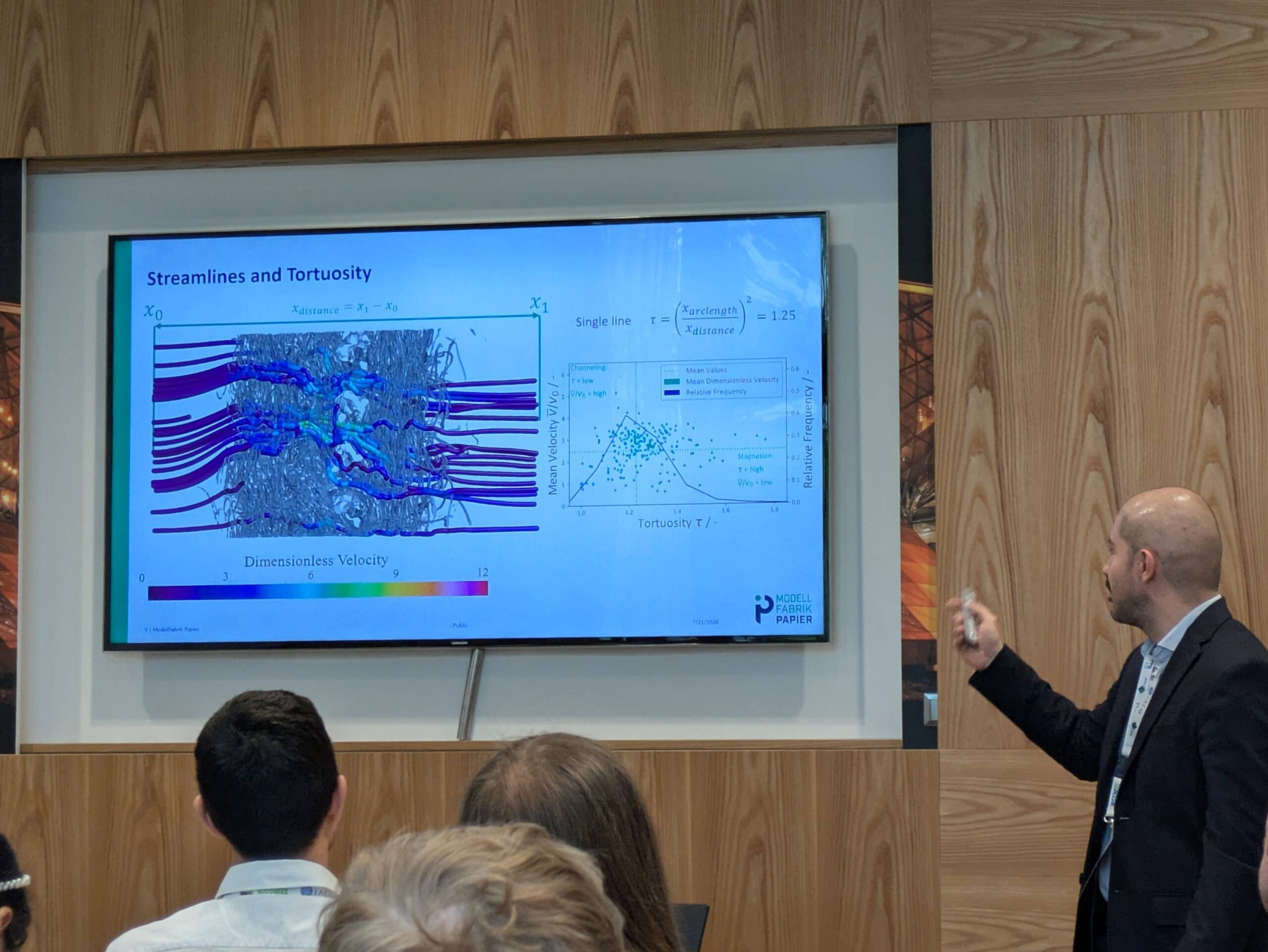
CFD simulations offer a fresh perspective on the interior of press felts. These findings pave the way for innovative solutions for the mechanical dewatering of paper.
in the industrial process, paper is still produced ‘wet’: fibres are suspended in water, separated, transported and evenly deposited to form a paper web. The water must then be removed, which is an energy-intensive process: more than 60 per cent of the energy required is used for thermal drying in the drying section.
One of the research approaches at Modellfabrik Papier therefore focuses on the preceding process stage of mechanical dewatering in the press section. The more water that is removed from the paper web at this stage, the less will subsequently need to be evaporated in an energy-intensive process. The amount of water that can be effectively pressed out of the wet paper web beforehand depends largely on one component: the press felt. Until now, very little has been discovered about what happens inside the press felt during dewatering.
A look inside the press felt
“The way water flows through the porous fibre structure of press felts has not yet been widely researched,” says Luis Miguel Estrada. The research assistant at Modellfabrik Papier’s research cluster FOMOP is investigating the flow behaviour in press felts. These consist of polyamide fibres arranged in a complex pattern to form a three-dimensional structure. During the pressing process, the felt absorbs the water displaced from the paper web. After the pressing impulse, however, the compressed material expands elastically back to its original state. In the process, water can flow back into the paper web – an effect known as re-wetting, which can impair dewatering performance.
“Although the structure and properties of industrial press felts have been comprehensively characterised, the fluid dynamics processes within their fine pore structure are not yet fully understood,” says Estrada. Gaining insights into these processes could offer new opportunities for optimising this stage of the process.
“The flow processes within the complex fibre structure of press felts have so far been poorly researched.”
From real felt to digital 3D modelling
In his research, Estrada uses a combination of modern imaging techniques and numerical flow simulations at the microstructural level to visualise the processes inside the felt. To investigate fluid transport within a press felt more closely, the three-dimensional microstructure was first captured using X-ray computed tomography (CT), which revealed the spatial arrangement of the fibres and the pores between them. This image data was then used to create a digital 3D model, which serves as the basis for numerical flow simulations. Using computational fluid dynamics (CFD), it is then possible to calculate how fluid moves through the complex felt structure, the resistance it encounters and the areas with particularly high flow rates. “This enables us to determine the permeability of the felt – that is, how easily fluid can flow through its pore structure – at various compression levels,” explains Estrada. “This brings us a significant step closer to a better understanding of the flow behaviour within the porous press felt.”
Simulation and Experiment in Unison
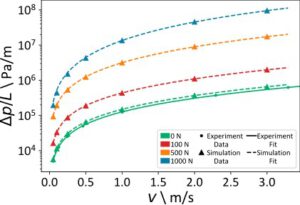 Parallel to the simulations, pressure loss measurements were carried out on the actual material to determine permeability and other flow parameters, and to validate the simulation results. In addition, changes in flow resistance at higher flow velocities were investigated.
Estrada recently presented these results at academic conferences. He reports a good correspondence between the simulation results and the experimentally determined values. Despite processing the CT scans via image binarisation, the simulation methods used can reliably reproduce the actual flow conditions and porosity values.
This marks an important milestone: “We can see that water does not flow uniformly through the press felt. The flow paths within the material are highly heterogeneous,” says Estrada, explaining his analyses. Some areas experience intense flow, while others absorb only a limited amount of water, contributing to its removal from the paper web.
“The simulation reveals how the structure of the felt changes under mechanical stress and how these changes influence the flow paths of the water. This understanding is an important step towards designing the wet press process more efficiently.”
New insights into flow dynamics
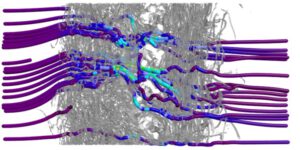 In future, this methodological basis will allow for an even more detailed analysis of the flow processes within press felts. “To apply this to the paper machine, we need to better understand exactly how the felt behaves under mechanical stress during the pressing process. Pores change their shape and size, flow paths are narrowed or reformed, and the permeability of the material changes. To gain a better overall understanding of these flow dynamics, I am therefore investigating various compression states to determine the effect of mechanical pressure on material properties,” explains Estrada. In the next phase, different types of press felts will also be examined, and their respective flow dynamics characterised.
Foundations for more efficient mechanical dewatering
The resulting model will facilitate an in-depth analysis of the dewatering process at a microscopic level, examining individual pores and flow paths within the material. Understanding the interactions between felt structure, compression and fluid transport will open up new possibilities for technical optimisation. In future, press felts could be evaluated more specifically in terms of how their internal structure affects water absorption, drainage and re-wetting.
“The research findings to date impressively demonstrate how the combination of modern simulation methods and experimental investigations provides new insights into the complex processes of paper production and paves the way for innovative industry solutions.”
The simulations provide insights not only into existing materials. In the long term, they can also support the development of new press felt structures, so that their pore geometry and material properties can be specifically tailored to improve dewatering performance and, consequently, achieve energy savings.
This is precisely where more efficient mechanical dewatering comes into play: If the dry content of the paper web can be increased while it is still in the press section, less water will need to be evaporated during the subsequent drying stage, resulting in lower energy consumption. Digital analysis of fluid flow within the press felt therefore improves our understanding of a key process step in paper production and helps to reduce energy consumption.