

What does it take to transform papermaking? New materials, smarter processes, less energy – or a completely different way of thinking about production?
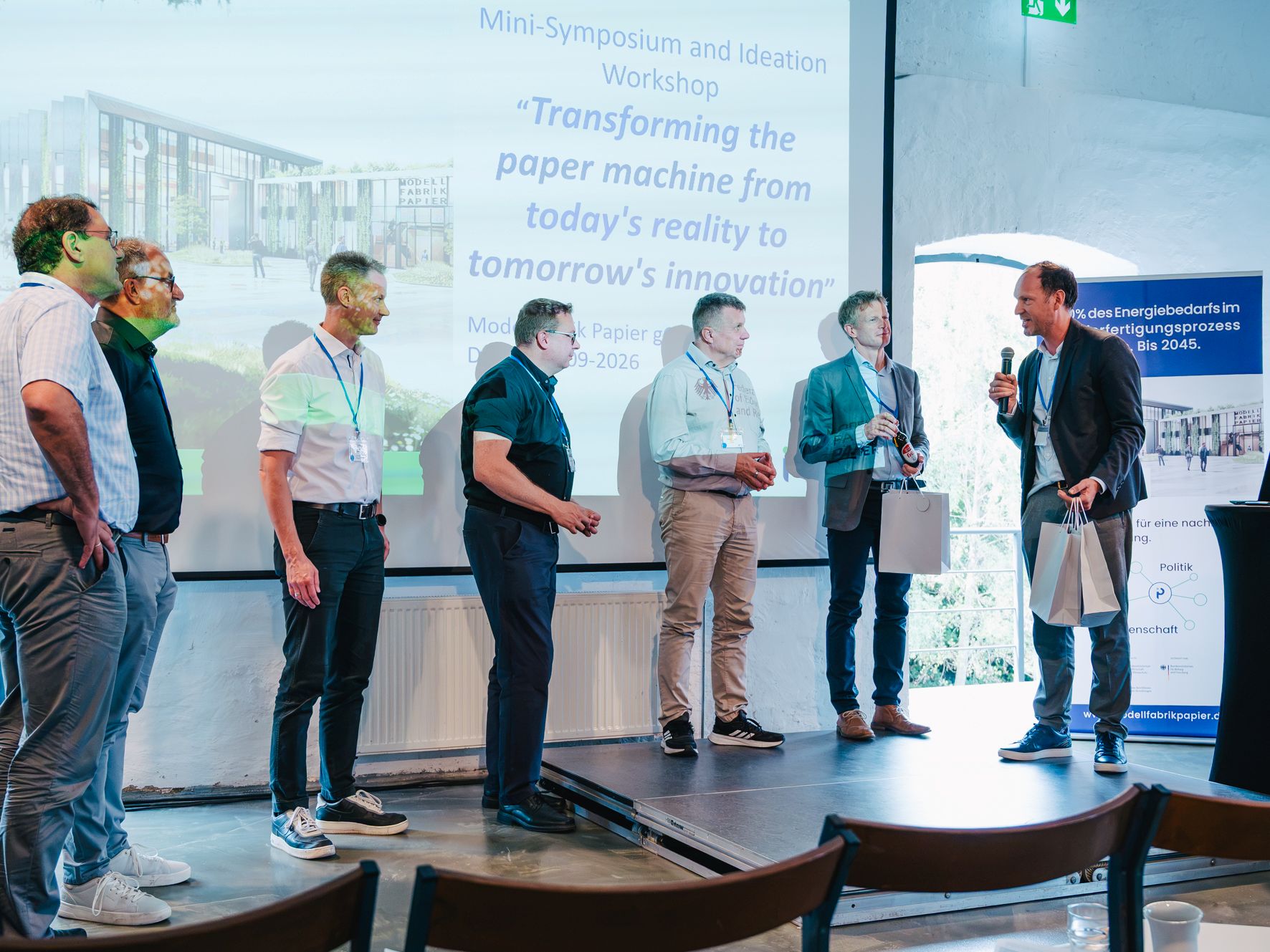
Answers to these questions are being sought in various parts of Europe. At the second Mini-Symposium of Modellfabrik Papier, held in Düren on 8 September 2026, more than 50 guests from the worlds of research and industry gathered to bring together different European perspectives on the transformation of papermaking. Under the theme “Transforming the Paper Machine: From Today’s Reality to Tomorrow’s Innovation”, the symposium deliberately looked beyond established processes.
Five keynote presentations by six experts offered five very different perspectives on where change might begin, which approaches are currently being pursued, and what can be learned from exchange across national, disciplinary and industry boundaries. The presentations ranged from material modelling and the limits of fibre recovery to more efficient use of raw materials and new concepts for web formation and drying. Ultimately, the focus was on how disruption can become a driving force for change.
For all their differences, the approaches shared one idea: there will not be one single, uniform solution for the paper machine of the future. Transformation emerges when different technologies, disciplines and experiences come together, and when energy demand, material use, product quality and industrial feasibility are treated as parts of the same task.
The symposium therefore offered far more than a series of individual research approaches. It traced a path from optimising existing processes to breaking with established principles, creating a basis for discussing where the decisive technological leaps in tomorrow’s fibre-based paper production might emerge – and what it will take to achieve them.
Some solutions may lie where no one is looking yet. Our five keynotes at a glance:
How much material does a carton really need?
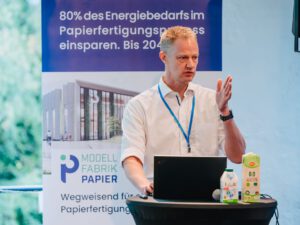
Can carton packaging use less material without sacrificing strength or functionality? Prof. Dr. Jaan Willem Simon, Head of the Chair of Computational Applied Mechanics at the University of Wuppertal, showed how simulation can help answer this question.
His research focuses on modelling and optimising materials and structures, particularly composites based on renewable resources. In his lecture, Simon presented a new model for simulating the creasing and folding of carton. More efficient and robust simulation of these processes allows for material properties and structural design to be optimised more precisely.
The broader potential lies in designing materials more efficiently from the outset. The amount or thickness of material required for a carton can then be reduced without compromising its quality or functionality. This also brings an indirect benefit for the industry: if a given product requires less material, less energy will be needed in the manufacturing process.
Less material, same performance
Such structural mechanics models are also relevant to Modellfabrik Papier’s research. They help researchers to better understand fibre networks and their mechanical properties. In dry fibre laying, for example, simulations support the design of network structures that require higher strength. Combining structural mechanics with computational fluid dynamics goes a step further. In future, it could lead to fluid–structure interaction models that allow the interplay between air flow and fibre structures to be analysed in greater detail.
How circular can paper become?
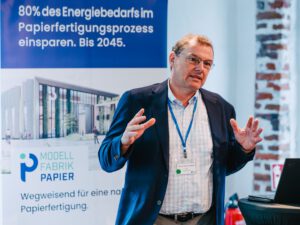
Paper is one of the most widely recycled materials. Yet recycling itself has limits. With each further cycle, the fibres change, their quality declines, and their behaviour during processing changes as well. Prof. Dr. Samuel Schabel, Head of the Institute for Paper Technology and Mechanical Process Engineering at TU Darmstadt, examined what this means for the future of circular paper production.
A higher proportion of recycled fibre reduces the need for virgin fibre and helps lower energy consumption and CO₂ emissions. At the same time, processing becomes more demanding as recycling rates rise and more material is kept in the loop: fibre quality declines over repeated cycles. Contaminants, coatings, additives and increasingly complex products also place greater demands on treatment processes and process water.
Closing the loop – and understanding its limits.
Another challenge is the introduction of new fibre sources in the recycling stream. Non-wood fibres, for example, may contain components such as pectin, proteins or silica, and their behaviour in established recycling systems is still not fully understood.
For Schabel, the conclusion is clear: recyclability cannot be assessed using a single parameter. Conventional parameters such as repulpability, screening results or visible impurities alone are not sufficient to predict how a material will perform over several recycling cycles. A robust assessment must therefore consider further factors including fibre ageing, morphology, mechanical strength, refining behaviour, pre-treatment and effects on process water.
This shifts the central question. What matters is not only whether a material can be recycled, but how well it performs over repeated cycles. A more comprehensive assessment can help identify more precisely where circularity brings genuine benefits – and where technological limits are reached.
Making more from every fibre
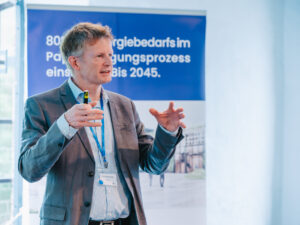
Wood is renewable, but that does not make it unlimited. Dr. Claes Holmqvist, Senior Scientist at RISE Research Institutes of Sweden, showed how papermaking can create more value from available resources. His Scandinavian perspective links more efficient use of materials with the question of how this can also reduce energy demand.
Holmqvist combines applied research with extensive experience in industrial papermaking, from pilot and full-scale trials to process development and the installation of paper machines. At RISE, he works closely with industry on processes that improve resource efficiency and product performance. His central message: future papermaking must create more function and value from every tonne of wood.
From fibre to function: How can papermaking use resources smarter?
The research approaches presented ranged from material design to digitalisation. In multi-ply board structures, fibres can be placed precisely where they contribute most to strength and stiffness. Fibre-based strength aids can in turn enable the use of coarser pulp blends. Fractionating recycled fibres also makes it possible to use different fibre qualities more selectively.
Digital tools are gaining importance at the same time. Adaptive machine settings can help reduce waste and improve operational efficiency. Digital twins make it possible to represent processes more accurately and optimise them further.
Drying remains a key lever. RISE is investigating technologies such as superheated steam and ultrasound-assisted drying. The aim is to improve the efficiency of this energy-intensive process step and reduce its resource demand.
Together, these examples point to a fundamental shift: resource-efficient papermaking will not emerge from a single technology. It requires a smarter use of fibres, more flexible processes and better control of energy and material flows, so that the industry can creat more value from the resources already available.
Less water, less energy, more possibilities
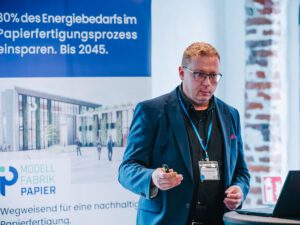
What if fibre-based products could be manufactured with significantly less water and energy, while remaining recyclable and scalable? Dr. Kristian Salminen and Harri Kiiskinen from VTT Technical Research Centre of Finland presented technologies designed to make exactly that possible.
Salminen leads VTT’s Biomass Processing and Products research area and brings more than 20 years of R&D experience in the forest industry, with expertise ranging from wood fibres and nanocellulose to papermaking chemistry and foam forming. Kiiskinen, Principal Scientist at VTT, specialises in fibre-based materials, process engineering and technology scale-up. Together, they cover the entire development chain, from laboratory research and pilot trials to industrial implementation.
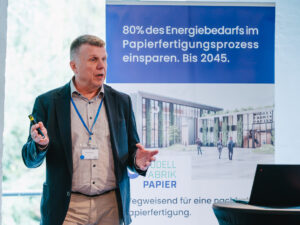
One focus of their work is alternative fibre-web forming technologies. Alongside conventional wet-laid processes, VTT is developing foam-laid and airlaid methods that can substantially reduce water demand. The research covers dry fibre handling, web formation, bonding technologies and higher process speeds. Flexible pilot lines can be adapted to the purpose of each study, allowing different raw materials and product structures to be tested under realistic conditions.
Can fibre production break free from water?
Drying offers another major lever. Superheated Steam Drying (SSD) replaces conventional hot air with superheated steam in a closed-loop system. This enables heat recovery and offers a potentially significantly lower energy demand. The research programmes presented at the symposium aim to reduce both water and energy consumption substantially, although the savings actually achieved depend on the process and operating conditions.
The overarching goal extends beyond individual process steps: to develop manufacturing routes for recyclable, low-carbon fibre products that not only work in the laboratory, but can also be validated, scaled up and transferred into industrial production. Applications range from paper and board to packaging, nonwovens, hygiene products, insulation and construction materials.
Turning disruption into a new business model
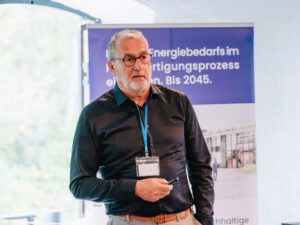
The final keynote looked beyond papermaking. Manfred Hermanns, Member of the Executive Board at Ecoclean, used his company’s experience to show what happens when a market changes fundamentally and established business models no longer work as they once did.
For many years, around 90 per cent of Ecoclean’s customers came from the automotive industry. The company focused on cleaning systems for components used in combustion engines and gearboxes. As the sector moves towards electric mobility and increasingly stringent emissions targets, demand for these applications is changing fundamentally. For Ecoclean, that meant entering new markets, developing new fields of business and looking beyond its established core business.
What happens when you market changes?
One example is decentralised hydrogen production. The technology is market-ready, but its commercialisation also illustrates how complex transformation can be. Technological maturity alone is not enough if investment conditions and market incentives are lacking. Ecoclean is therefore examining further applications in other industries, including solutions for energy recovery and the potential use of hydrogen as an alternative to natural gas.
Hermanns’ key message went far beyond individual technologies. Transformation requires external pressure, but also the willingness to act before all conditions are perfect. Setbacks are part of the process, communication must continue, and reliable partners play a crucial role.
His experience offered a perspective that resonates with the paper industry. Disruption can put established business models under pressure. At the same time, it can provide that starting point for new technologies, partnerships and markets.
Input for the Ideation Workshop
The presentations provided the basis for the ideation workshop that followed. Guided by a facilitation team, participants were encouraged to look beyond their own fields of research – and beyond the paper industry itself – to explore potential new research questions. After all, some of the answers to the challenges facing papermaking may be found in places where no one is looking yet.