



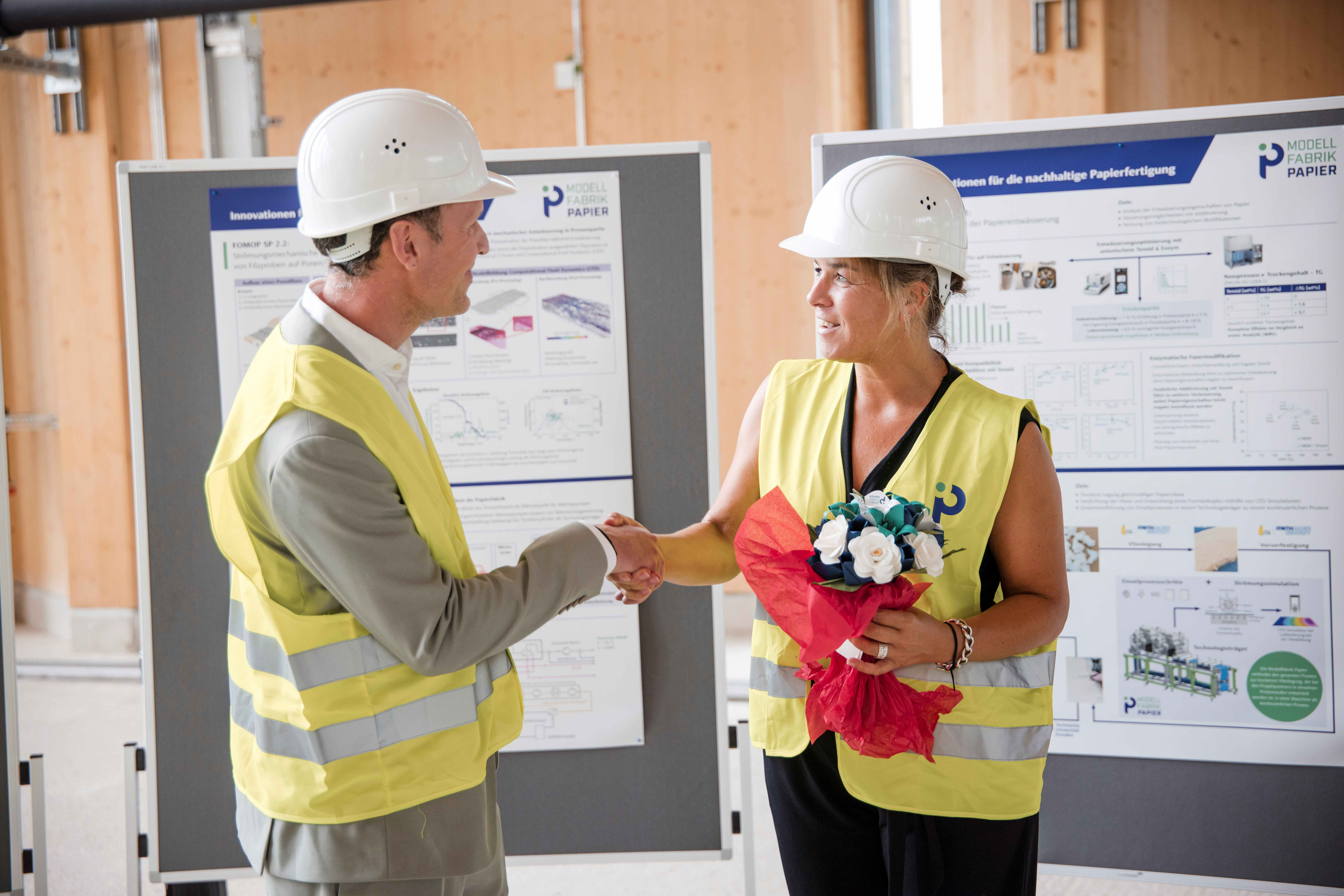
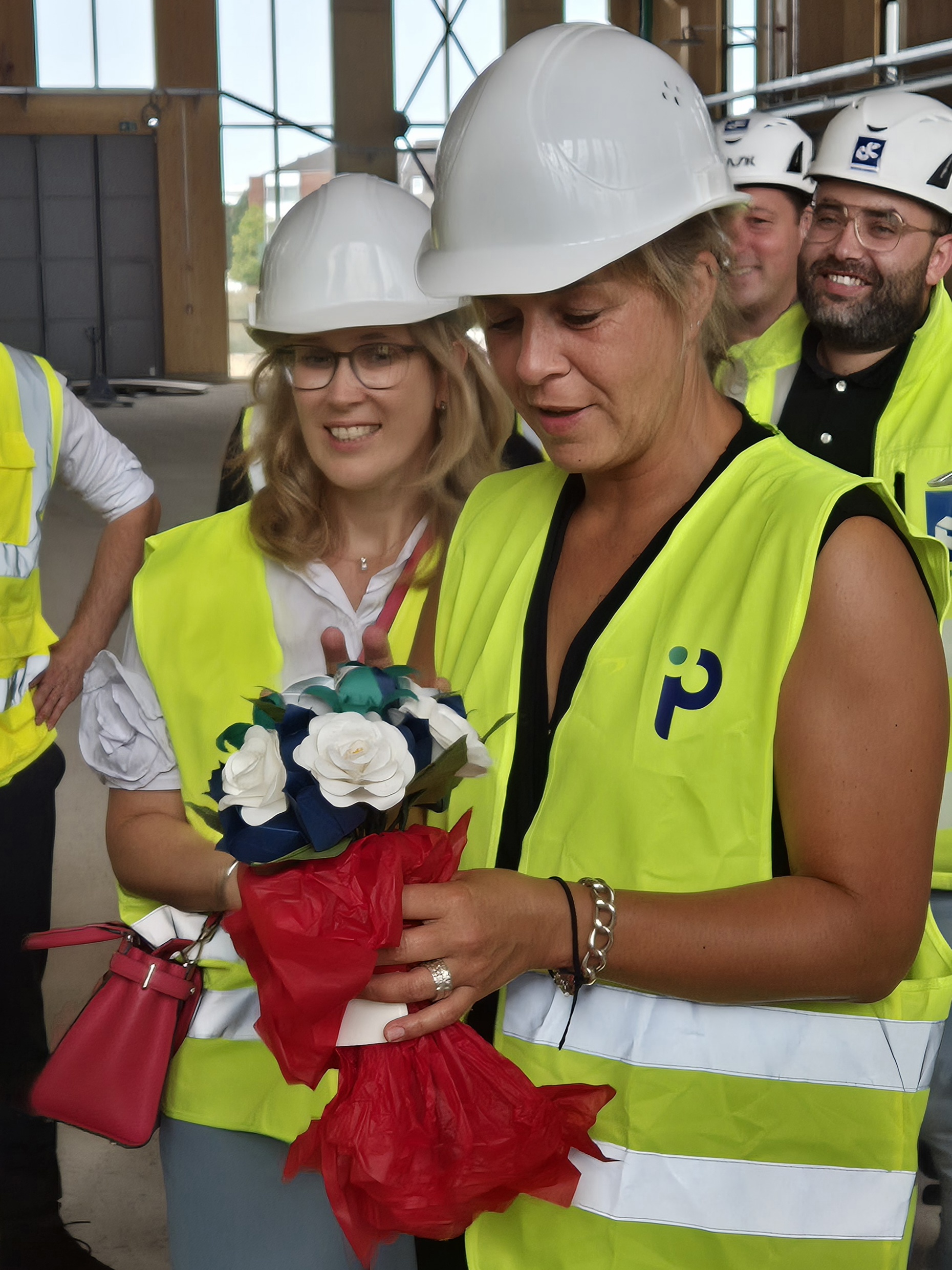
At the end of her visit, NRW Minister for Economic Affairs Mona Neubaur received a flower bouquet, that is, from a technological perspective, more unusual than it first appears: the white origami roses are made from the first paper to be produced without water at the Modellfabrik Papier’s pilot plant.
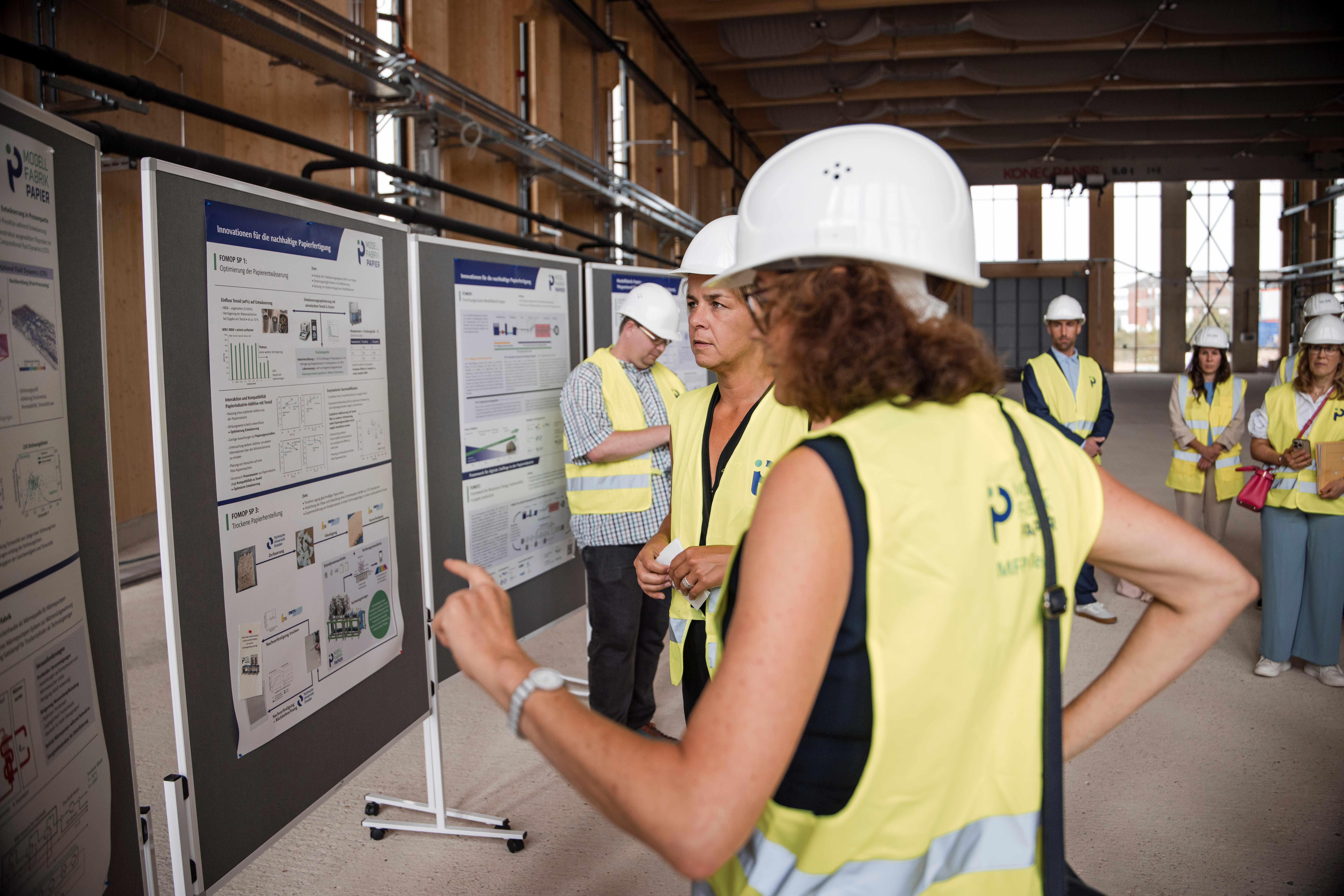
During her summer tour of the Rhenish mining area, NRW Minister for Economic Affairs Mona Neubaur visited the Düren Innovation Quarter and toured the almost completed new building of the Modellfabrik Papier. It was the third stop of the day on her tour of flagship projects in this region undergoing structural change. Whether semiconductor, textile or paper production: all three projects share the aim of translating research innovations into industrial value creation.
At the end of her tour, the NRW Minister for Economic Affairs was presented with a bouquet of flowers. The bouquet marked the conclusion of a visit that was about far more than just a new building. The focus was on how scientific ideas are transformed into new technologies that make their way from the laboratory into industrial application. “The key lies in the transfer and the speed with which innovations reach industry,” emphasises Peter Bekaert. Looking at the traditional innovation cycles of the paper industry, the policy goal of climate neutrality by 2050 is just two paper machines away. Meanwhile, the demands of transformation are increasing the pressure on companies to prepare themselves for the future. The research progress made at the Modellfabrik Papier demonstrates that groundbreaking innovations do not arise in isolation, but through the joint efforts of industry and science.
The focus includes, amongst other things, new approaches to dewatering and drying, as well as processes that are still a long way from becoming industrial standards today. The paper flowers are a case in point: the roses are made from the first dewatered paper to have been formed without water and subsequently consolidated at the Modellfabrik Papier’s pilot plant. They symbolise what the research building’s technical centre will be all about on a large scale in future: challenging established processes in industrial paper production and paving the way for new approaches to paper manufacturing.
Innovations do not arise in isolation
“No single company or research discipline can provide the solution on its own,” explains Bekaert. A place is needed where industry and science can bring their knowledge and different perspectives together. Under the umbrella of the ‘Modellfabrik Papier’, entirely new process concepts are jointly developed, tested and scaled up. This has the advantage that development efforts and responsibility are shared amongst several parties.
“Düren plays a key role through its flagship project, the Modellfabrik Papier. This is innovation ‘made in NRW’: when sustainable industry and economic development go hand in hand”, said Mona Neubaur, NRW’s Minister for Economic Affairs.
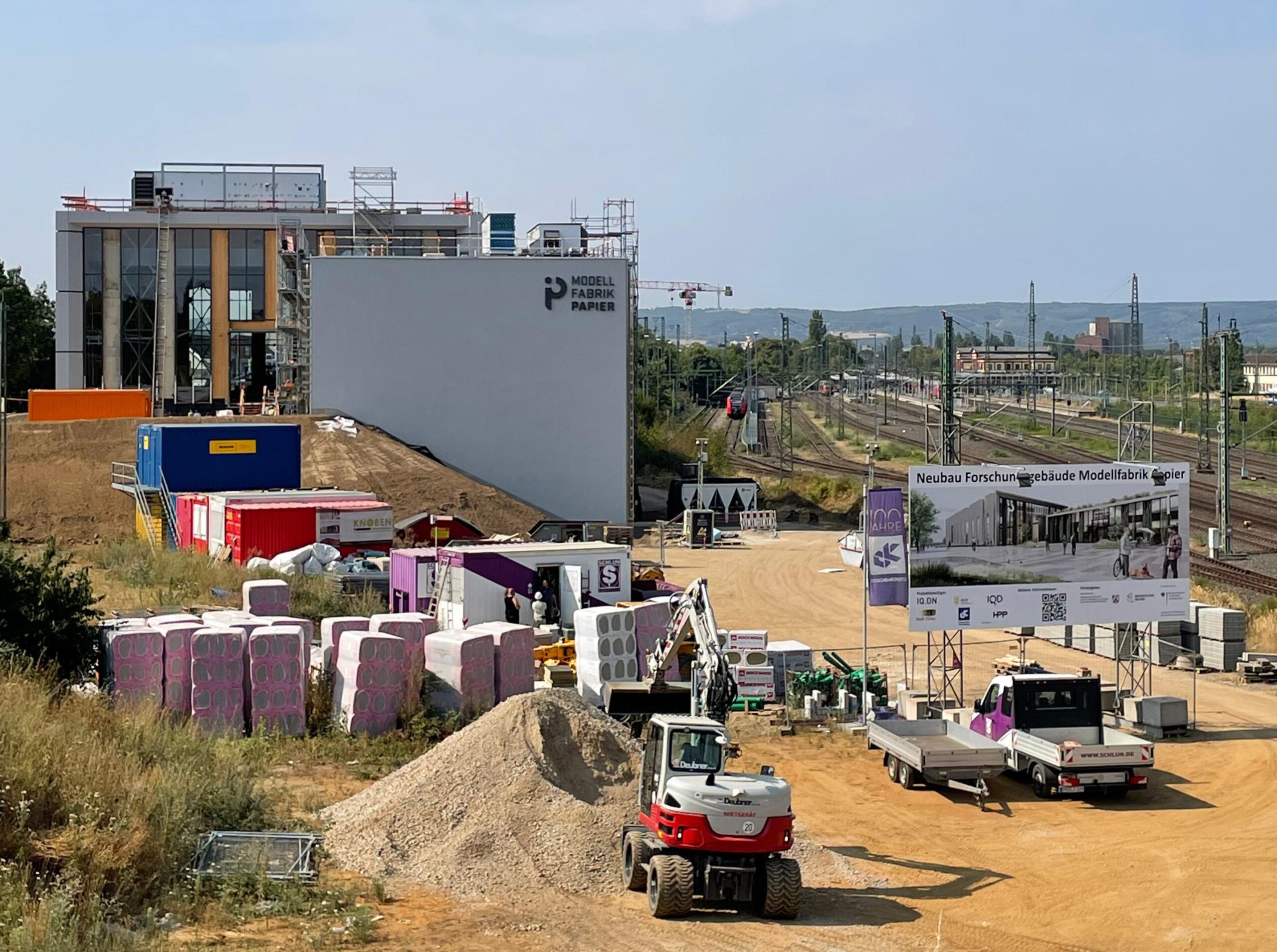
During her tour, the Minister was briefed on the progress of the new building, which is itself setting new standards: as one of the first laboratory and research buildings in Germany, the new building has been awarded DGNB Platinum certification. “This demonstrates that sustainable thinking begins with the infrastructure itself,” said Bekaert. “Technically, the building is designed in such a way that it can adapt to changing usage requirements arising from research and future scaling.” At its heart is the two-storey technical centre, where new processes and technologies are being further developed – technologies that are already being designed and tested at the interim sites and by the research partners of the Modellfabrik Papier.
Five prototypes under development
The research approaches are diverse and focus on the various stages of the paper-making process. The targeted modification of the properties of pulp fibres is intended to influence the extent to which water is bound to the fibres. If it can be removed more easily by mechanical means, the energy required for the subsequent drying of the paper web is reduced. Another research approach focuses on mechanical dewatering in the press section and examines exactly how press felts contribute to the re-moistening of the paper web – and how this could be altered. A further field of research focuses on the drying section of the paper machine and investigates how energy can be recovered from the moist exhaust air, recirculated and reused as process heat, thereby reducing energy consumption.
Five prototypes are currently under development. These include waterless paper formation, which promises an entirely new process route for paper production. The roses made from dried paper are a small demonstration piece. They show how an unconventional idea, combined with collaboration between various research partners, can lead to the transfer of knowledge from fundamental research into practical application.
A blossoming piece of research, in fact.
You are currently viewing a placeholder content from Vimeo. To access the actual content, click the button below. Please note that doing so will share data with third-party providers.
More InformationYou are currently viewing a placeholder content from YouTube. To access the actual content, click the button below. Please note that doing so will share data with third-party providers.
More InformationYou need to load content from reCAPTCHA to submit the form. Please note that doing so will share data with third-party providers.
More InformationYou are currently viewing a placeholder content from Google Maps. To access the actual content, click the button below. Please note that doing so will share data with third-party providers.
More InformationYou are currently viewing a placeholder content from Google Maps. To access the actual content, click the button below. Please note that doing so will share data with third-party providers.
More InformationYou are currently viewing a placeholder content from Mapbox. To access the actual content, click the button below. Please note that doing so will share data with third-party providers.
More InformationYou are currently viewing a placeholder content from OpenStreetMap. To access the actual content, click the button below. Please note that doing so will share data with third-party providers.
More Information