



Breakthrough innovations rarely emerge from well-trodden paths. In energy-intensive industries in particular, more is needed than the continuous optimisation of existing processes: what is required are new technological approaches, new forms of collaboration and a consistent link between research and industrial application.
This issue is particularly relevant to the paper industry. The sector is under intense pressure to change: energy efficiency, CO₂ reduction, economic competitiveness and new requirements for sustainable production must all be reconciled. However, the solutions required to achieve this can rarely be developed in isolation. They emerge where companies and leading research institutions pool their expertise within a shared development space.
“Anyone who wants to shape the industry of tomorrow must not rely solely on yesterday’s optimisations. Major leaps in efficiency occur where new technologies, scientific findings and industrial application come together at an early stage.”
The Modellfabrik Papier is one such place where paper manufacturers, suppliers and plant engineers work closely with the scientific community. “We bring together industrial know-how, scientific excellence and applied research within a shared innovation network. Manufacturers, suppliers, plant engineers and research partners work under our umbrella to develop new technologies for energy- and resource-efficient paper production and to bring them to practical application,” says Managing Director Peter Bekaert.
Innovation arises from networking
Many companies develop new solutions within their own structures. This leads to significant improvements to existing processes. Fundamental technological changes, however, require a perspective that extends beyond company boundaries. “To break with conventional ways of thinking and develop marketable innovations, we must re-think and bring together knowledge that is spread across individual companies and research areas,” says Bekaert.
“As an enabler, the Modellfabrik Papier bridges scientific knowledge with practical application, transforming early-stage research concepts into robust development pathways for the paper production of tomorrow.”
Within the research consortium, the Modellfabrik Papier facilitates the targeted transfer of scientific findings into industrial application – something individual companies would find difficult to achieve on their own to this extent and depth. This brings numerous benefits for shareholders and industry partners: specific industry challenges are addressed in a targeted manner; different perspectives converge earlier within the shared innovation space; multiple technological pathways can be pursued in parallel; and development decisions can be prepared on a more sound basis.
Bringing technology development to maturity more quickly
Promising technologies rarely fail because of the idea itself. The greatest challenge often lies in the transition from research to industrial application. “We know from the innovation sector that the path from the laboratory to market readiness is long and arduous,” explains networking manager Dominic Laaf. “In between lie complex scaling issues, high development costs, investment risks and the question of whether a new approach is truly viable under real-world conditions.”
The Modellfabrik Papier addresses these challenges with a structured innovation pathway. Promising research approaches are assessed, further developed to a technologically level and brought to higher stages of maturity through prototypes, test benches and, in the longer term, pilot and demonstration plants. In this way, early ideas are transformed into robust solutions with concrete prospects for the paper production of tomorrow.
“We examine paper-making processes from various angles and through different lenses,” emphasises Bekaert. “It is crucial that we consistently focus our research on effectiveness and implementation.”
By the industry, for the industry
The Modellfabrik Papier was established by the industry itself. Currently, 24 shareholders from the paper industry – including manufacturers, suppliers and plant engineers – are supporting the joint endeavour. Seven research partners contribute expertise in paper chemistry, the bioeconomy, process and engineering technology, digitalisation and resource-efficient energy systems.
As shareholders, companies gain early access to new technologies, can help shape research questions, contribute to the design of technology transfer pathways and build up practical experience in the early stages of development. Research partners contribute their scientific excellence across various disciplines relevant to paper production. Currently, over 20 research topics are being addressed within the consortium and supported by public funding. The first prototypes are under development. “With our Stage-Gate process, we ensure that only those solutions are taken forward which demonstrably have a significant impact on energy consumption and the life cycle assessment (LCA),” explains Laaf. This is because what works well in the laboratory and appears promising as an individual measure may generate additional costs elsewhere and fail in the industrial process due to robustness issues or cost considerations. “In this way, we ensure that our technologies are scalable, technically viable and energy-efficient – thereby minimising innovation risks for companies.”
A new phase for joint development
With the current investment period coming to an end at the turn of the year, a new phase is beginning for the Modellfabrik Papier. The focus is shifting from set-up to further development, and from establishment to consolidation. The next stage offers the opportunity to strengthen the network, involve further companies and continue joint technological research in a way that is closely aligned with practical applications.
“We are open to new shareholders who wish to participate in the second investment period from 2027 onwards.”
In future, the research network intends to open up even further beyond the traditional paper industry. “The paper industry cannot be viewed in isolation. Production processes, material flows, energy issues and circular systems are all interconnected,” emphasises Bekaert. Future solutions could therefore also emerge from expertise in neighbouring or entirely different sectors – such as recycling, material cycles or systemic resource utilisation. For companies from other sectors, participation in the Modellfabrik Papier could be attractive: they gain early access to technological developments and potentially new market opportunities, whilst the research work receives fresh impetus for innovation and new process approaches.
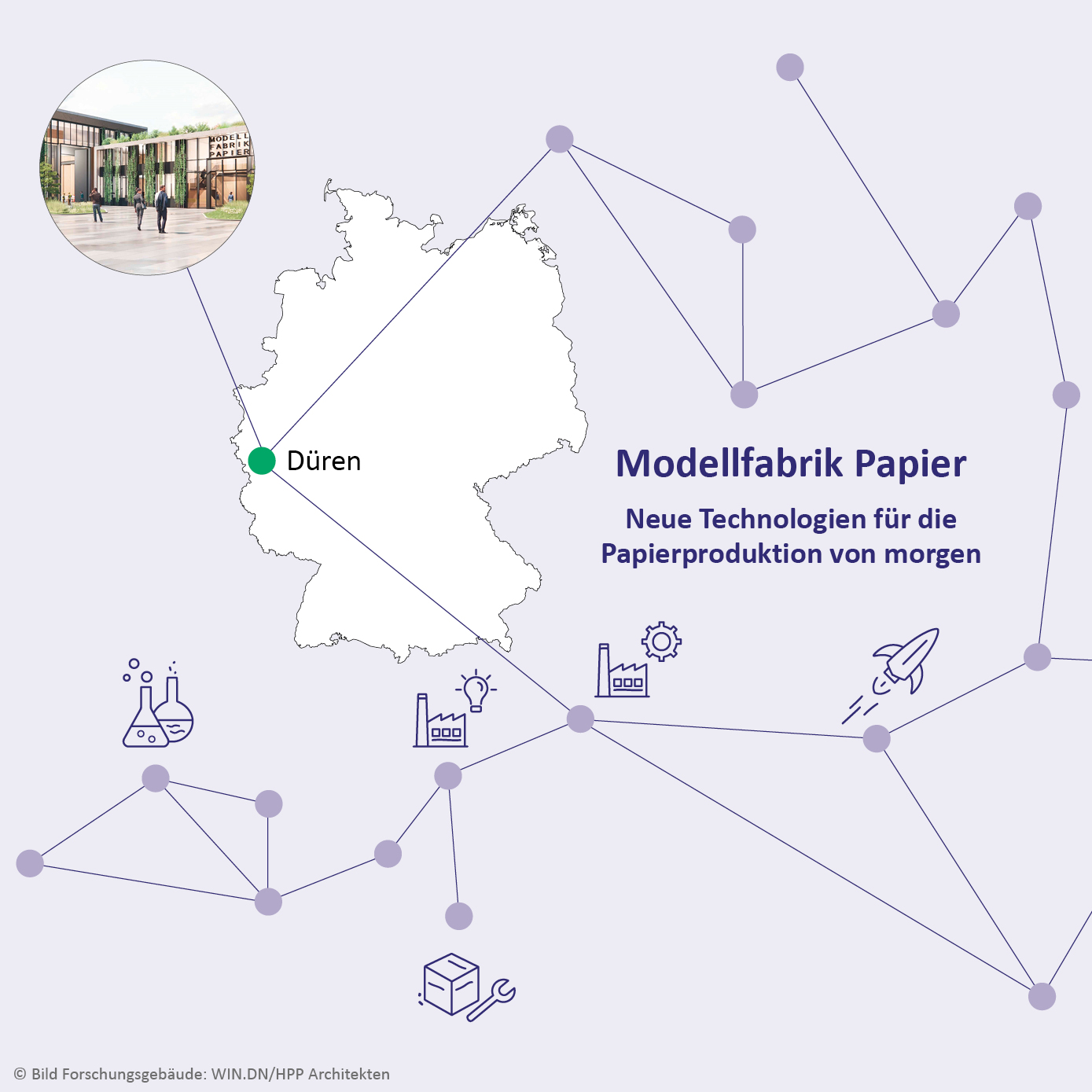
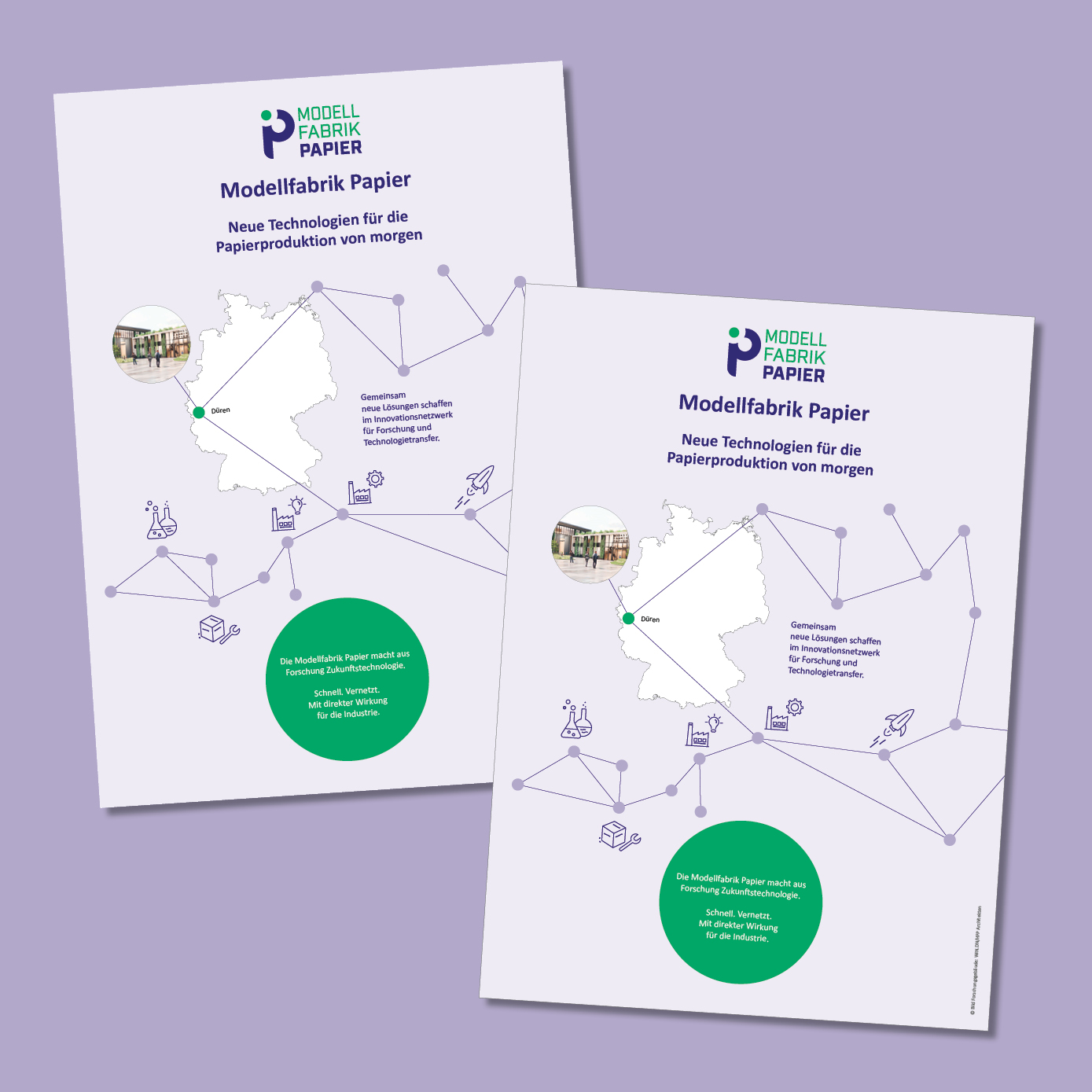
The new brochure ‘New Technologies for Tomorrow’s Paper Production’ outlines the specific innovation pathway of the Modellfabrik Papier, details the research projects currently underway, and explains the opportunities for participation. It is available in German in our Mediathek.
Groundbreaking solutions for the paper production of tomorrow are not developed in isolation. They emerge from a strong innovation network where companies and research institutions come together. Would you like to help shape new technologies at an early stage and drive research consistently through to market readiness? Get in touch with us!
Feel free to contact us if you would like to find out more about Modellfabrik Papier, our tasks and our projects.
Feel free to contact us if you would like to find out more about Modellfabrik Papier, our tasks and our projects.
Click on the button below to load the content of Brevo to subscribe to our newsletter.