The research carried out at the Modellfabrik Papier is intended to create real impact. To ensure that promising technological innovations do not remain stuck in development but make the leap into industrial application, Jimena Martinez Diaz and her team assess their energy requirements, environmental impacts, and industrial feasibility. In the interview, the research group leader explains why this systemic approach is essential for successful technology transfer – and how it accelerates the development of market-ready applications.
_________________________________________________________
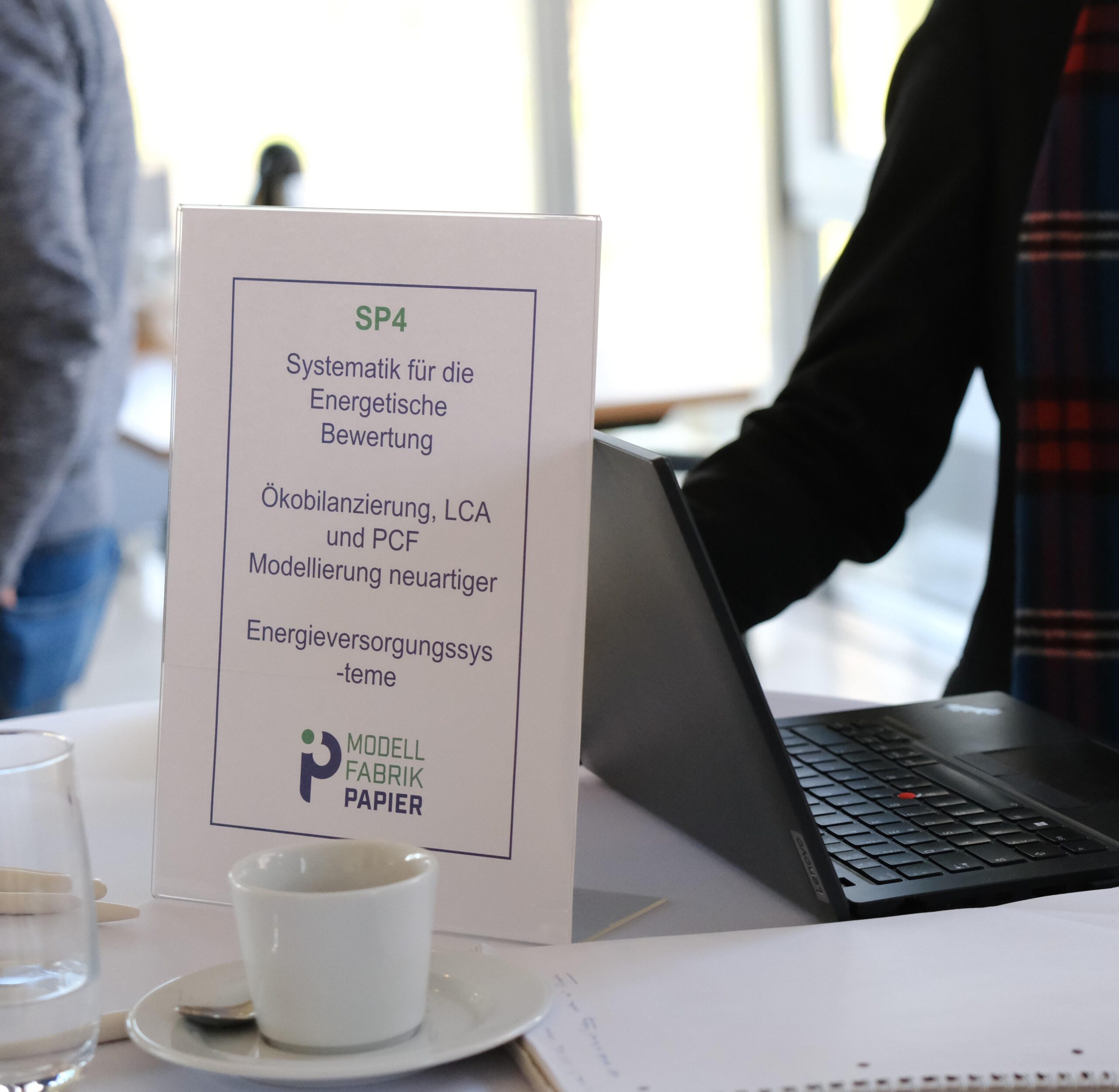
SP4 is the integrative heart of Modellfabrik Papier
In Research Area 4, “Systemic Integration”, the results of the FOMOP research cluster (Forschungscluster Modellfabrik Papier) converge: SP1 modifies the properties of fibres in order to manufacture paper using less energy, SP2 develops new process strategies for existing paper machines, SP3 explores entirely new, disruptive approaches – such as paper production without water. SP4 systematically evaluates these innovations and develops methods to measure energy efficiency gains, calculate resource consumption and CO2 emissions over the entire life cycle, and assess recyclability. It also investigates how well the new technologies can be integrated into existing material cycles and production systems.
________________________________________________________
SP4 brings together the different research strands in FOMOP. How would you explain its purpose and why it matters, in one sentence?
Okay, that is not so easy. Let’s see… While the other three FOMOP-subprojects do research on new materials – such as modified fibres that have a lower water retention level – and develop new technologies like producing paper without water as a carrier medium, my group takes a step back and looks at the bigger picture.
We focus on systemic questions. We evaluate how feasible these innovations really are: How much energy do they require? What are their environmental impacts? Another important aspect is, how they can be integrated into real industrial processes. We also look at the whole life cycle: Once the new materials exist, can they be recycled? Can they be reused? Can they be re-fed into the production process?
Why is this so important? Because research does not end in the laboratory – it has so work in the real world. This is precisely where the challenge of research transfer often arises: individual technical solutions may appear promising, yet later fail due to a lack of integration, unforeseen interactions, or economic risks.
So, to answer the question: In short, we try to make sure that our technologies we develop become solutions – without solving one problem and thereby creating new problems down the line.
FOMOP brings together various research partners. SP4 also works in a transdisciplinary manner. You personally appreciate this research approach at Modellfabrik Papier. Why?
Because the challenges that the paper industry faces and that we are addressing cannot be solved within one single discipline. You can’t evaluate a technology purely from one scientific angle, say from a materials perspective, and ignore its energy demand, its environmental consequences or recyclability. You have to make sure that it is applicable and robust, creating real added value.
Therefore, we need to work transdisciplinary. Together with our scientific partners from Institute NOWUM-Energy at FH Aachen we develop evaluation and scoring systems to assess energetic performance and to conduct life cycle assessments and product carbon footprints. We also work closely with the team from SP1 to assess the recyclability of modified fibres, linking lab-scale research to industrial reality. Moreover, we build the data infrastructure that ensures all research results from all FOMOP-subprojects are structured and usable across FOMOP.
So different disciplines don’t just work next to each other – they are collaboratively combined within one framework. Materials science, energy engineering, environmental assessment and data management all interact. Yes, that is challenging at times (laughs). But it’s very necessary if we want to develop solutions that actually work in the real world. For me personally, this way of thinking feels both necessary and very motivating.
You are a biotechnologist and you have just submitted your doctoral thesis, yet you switched from science to applied industrial research. What motivated you to make this change?
Curiosity! (smiles) And a strong desire to move from understanding problems to actively work on solutions. I started with environmental sciences because I wanted to understand the causes of our environmental crises. But at some point that felt overwhelming, so I moved into energy and environmental engineering, focusing on renewables, and later on trees as biomass and less energy-intensive methods in pulping processes during my PhD. Over time, I realized I was particularly interested in applied evaluation — in understanding trade-offs, feasibility and real-world implications. In my group, my role brings all of that together. It allows me to apply knowledge rather than only generate it.
“SP4 ensures that good ideas become robust solutions – and that innovations do not remain at the experimental stage but make their way into industrial application.”
As an innovation network, the Modellfabrik Papier bridges the gap between science and industry. What role does your groups work play in that?
Our work is very much that bridge. Academic research generates a lot of knowledge but often works with theoretical values and idealized conditions — which is important. But the real world operates under many different constraints. Our work package is essentially about integration. We need to link our technology innovations with the industry as they emerge. To do so, we initially take scientific results and translate them into industrial practise. We involve industry partners, use reference cases that are closer to real production and test assumptions against practical conditions. That makes our evaluations and assessments more robust and more relevant beyond academia.
What has been the biggest challenge in building SP4 so far and what are the next milestones?
My group only recently completed its team, and our work has been picking up speed. At this stage we are providing a structured basis for evaluation along the way from lab scale to higher technology readiness levels. Since we rely on the progress of the other subprojects, their delays delay us. However, we made substantial progress in very short time. One of our biggest achievements has been establishing clear methodologies and processes. Building it took time, trial and error — but now we have a framework that works reliably.
Looking ahead, well I have to take a little pause while I am on maternity leave. I am extremely grateful for my team to take our work further ahead. I hope that most technologies will have been evaluated, that we have a solid data infrastructure in place, and that we are well into the first experimental stages of recyclability research. More than anything, I hope the group continues to move forward with clarity and confidence — and that the path we have set together will lead to good solutions.
Thank you very much for talking to us.