



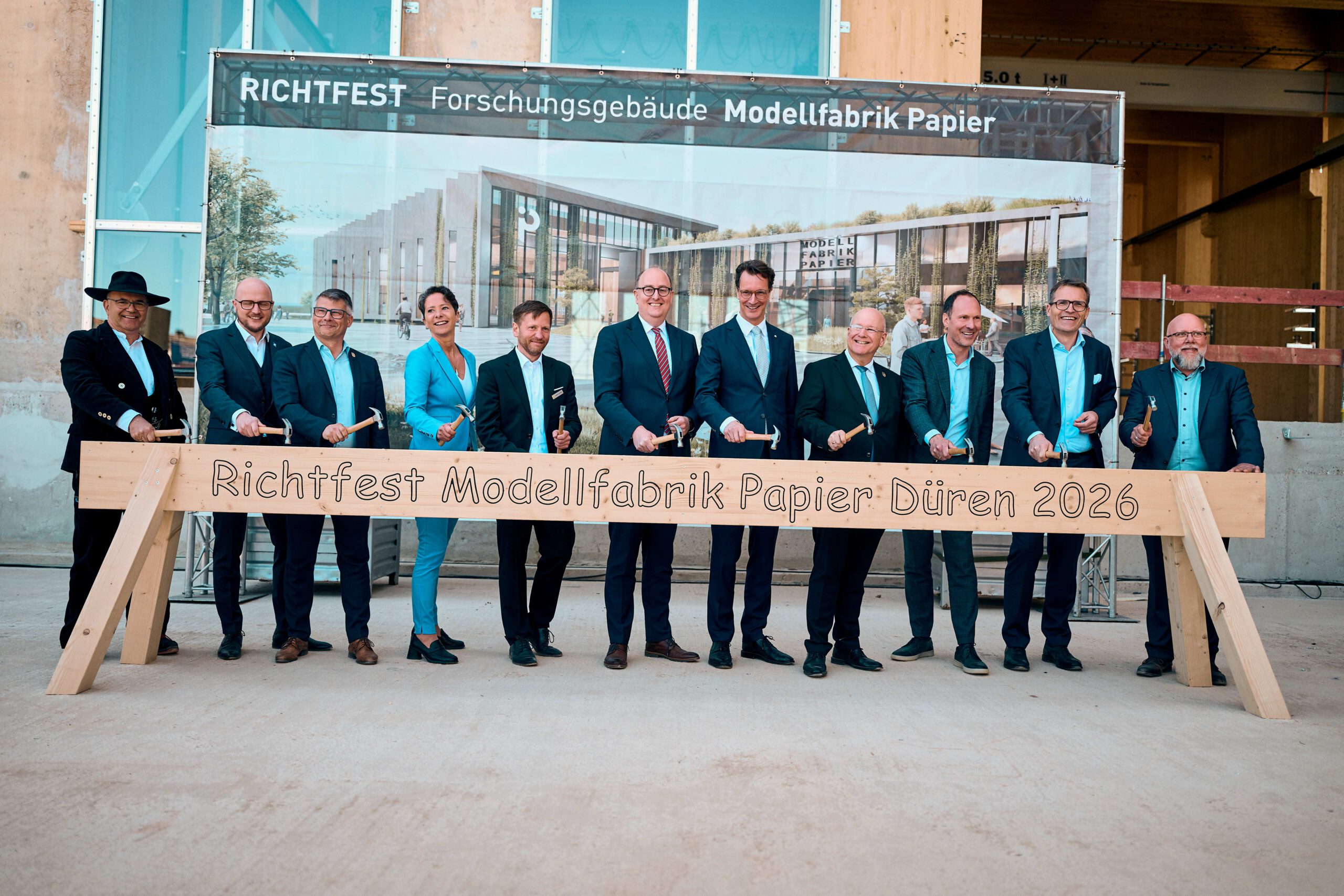
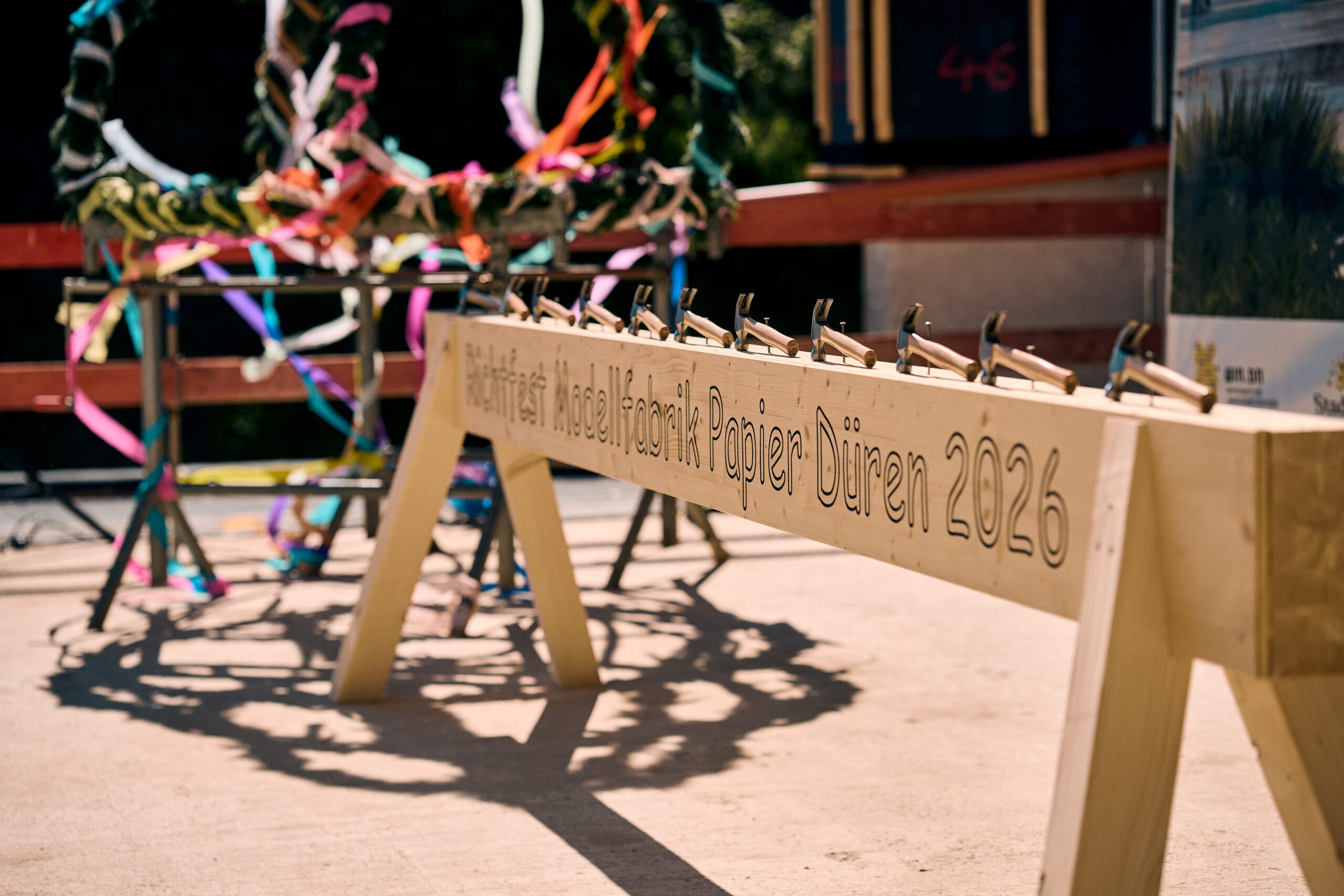
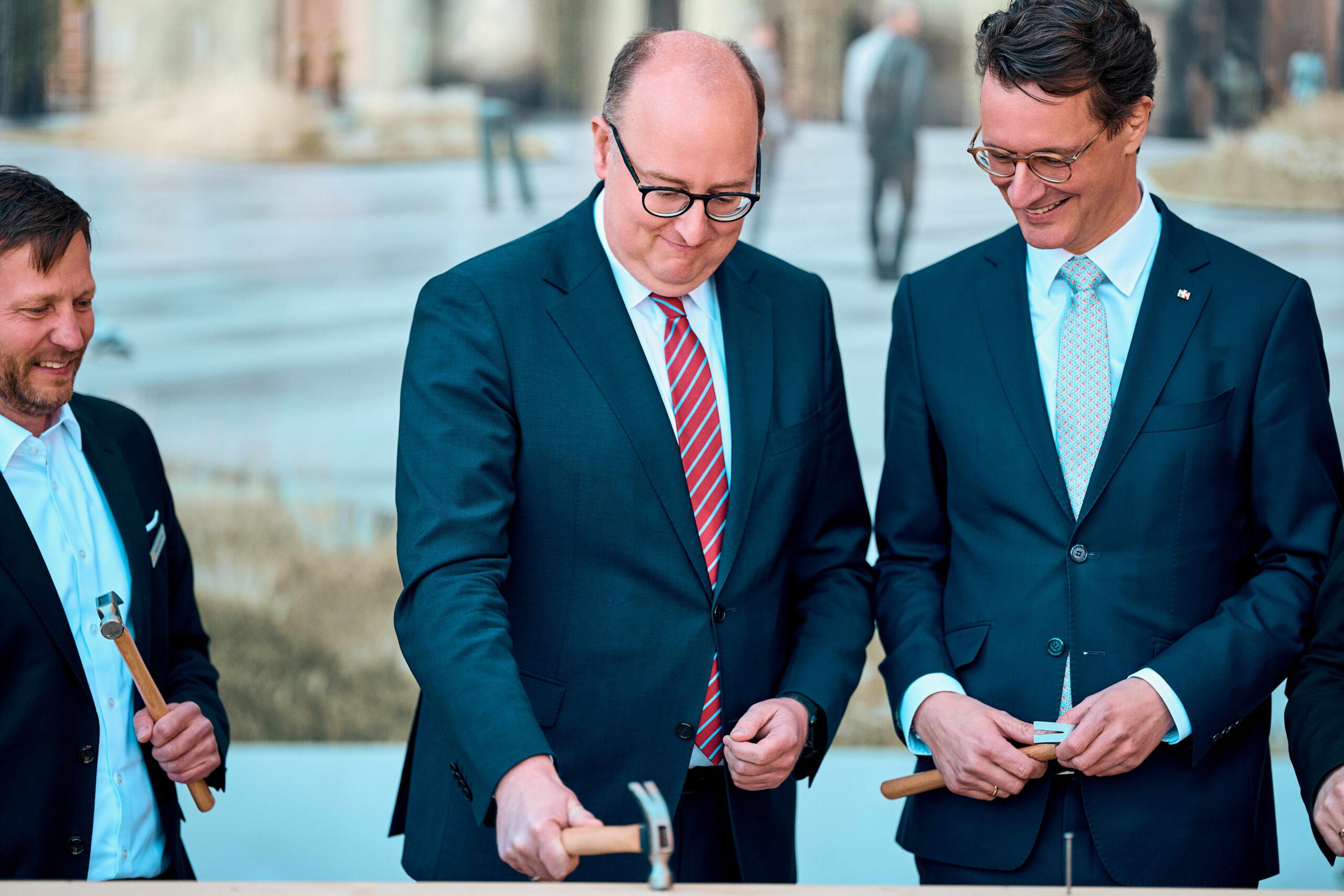
The State Prime Minister of North Rhine-Westphalia left no doubt that paper production has a long tradition in Düren. After all, the original copy of the German Basic Law and the Treaty on German Unity were printed on handmade paper from Düren, he explained in his speech at the topping-out ceremony for the Modellfabrik Papier. With the symbolic final hammer blow, another milestone in the history of the paper town was celebrated today in Düren. This marks the completion of the structural work on the new research building for the Modellfabrik Papier; the building is due to be finished by the end of the year.
“The Modellfabrik Papier demonstrates how successful structural change works in North Rhine-Westphalia,” said Wüst. The innovation centre, which is unique in Germany and where science and industry work together on a climate-neutral and competitive industry, strengthens the region’s economic base. Through its research, it makes a key contribution to securing thousands of industrial jobs.” State Minister for Economic Affairs Mona Neubaur also emphasised in her video message to the guests the importance of the project, which, as an anchor project for structural change in the Rhenish mining area, demonstrates how industrial transformation can be driven forward in an exemplary manner through strong partnerships alongside the phase-out of lignite mining.
Scientists from seven research institutions are joining forces with industry in the Modellfabrik Papier innovation network to find new technological solutions that will enable paper to be produced with significantly lower energy consumption in future. By 2045, disruptive, fundamentally new production methods are expected to enable an 80% reduction in specific energy consumption in paper production. Around 19 million tonnes of paper were produced nationwide last year. Per tonne, companies require around 2,800 kilowatt-hours of energy. This roughly corresponds to the average annual electricity consumption of a four-person household. Over 60% of the energy is used solely for drying the paper web. How this could be done differently is to be researched, tested, scaled up and transferred to industrial application in the new research building.
Since 2020, the non-profit research organisation, together with the Economic Development Agency of the city of Düren (WIN.DN) and IQ.DN GmbH, has secured structural change funding from the state and federal governments for planning and new construction, networking, research infrastructure and research work. A large part of this is being channelled into the new building. With around 5,400 square metres of floor space, it offers researchers every opportunity: “In addition to wet and dry laboratories for areas such as fibre chemistry and dewatering analysis, we are getting a large technical centre here with plenty of space for test benches and pilot plants – and the particular advantage that it can be technically adapted to future research questions that we do not yet know today,” explains MPF Managing Director Peter Bekaert.
This flexibility is reflected in the research activities. “Upon receiving the funding for our basic research project FOMOP in mid-2023, we immediately began implementing our more than 100 work packages,” reports Bekaert. During the construction of the new building, the scientific teams are working at two interim sites in Jülich and Düren, as well as at the sites of the seven participating research partners. Research is being conducted into solutions across the various process stages in industrial paper production – from fibre chemistry and altering the water absorption capacity of fibres to the use of high-temperature heat pumps in the drying section of paper machines.
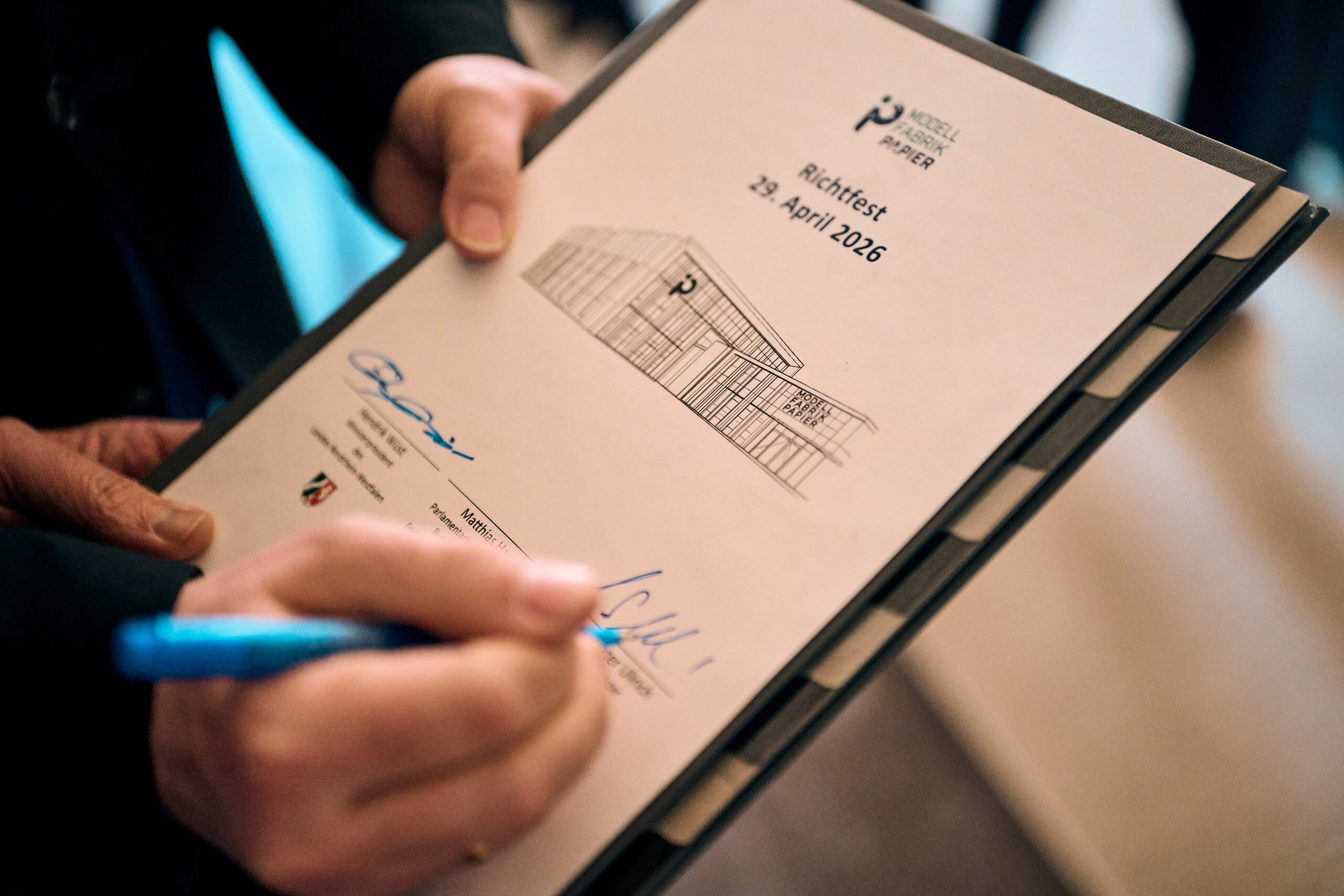
State Secretary Matthias Hauer from the Federal Ministry of Research learned about what is arguably the most disruptive research approach – producing paper entirely without water – during a discussion with the research group leaders on the sidelines of the ceremony. He emphasised that the Modellfabrik Papier is an important future-oriented project that serves as a model. The Federal Ministry of Research is funding the research project with more than 10 million euros. A further sum of just under 10 million euros from state funds is being channelled into the development of the research infrastructure in laboratories and the technical centre.
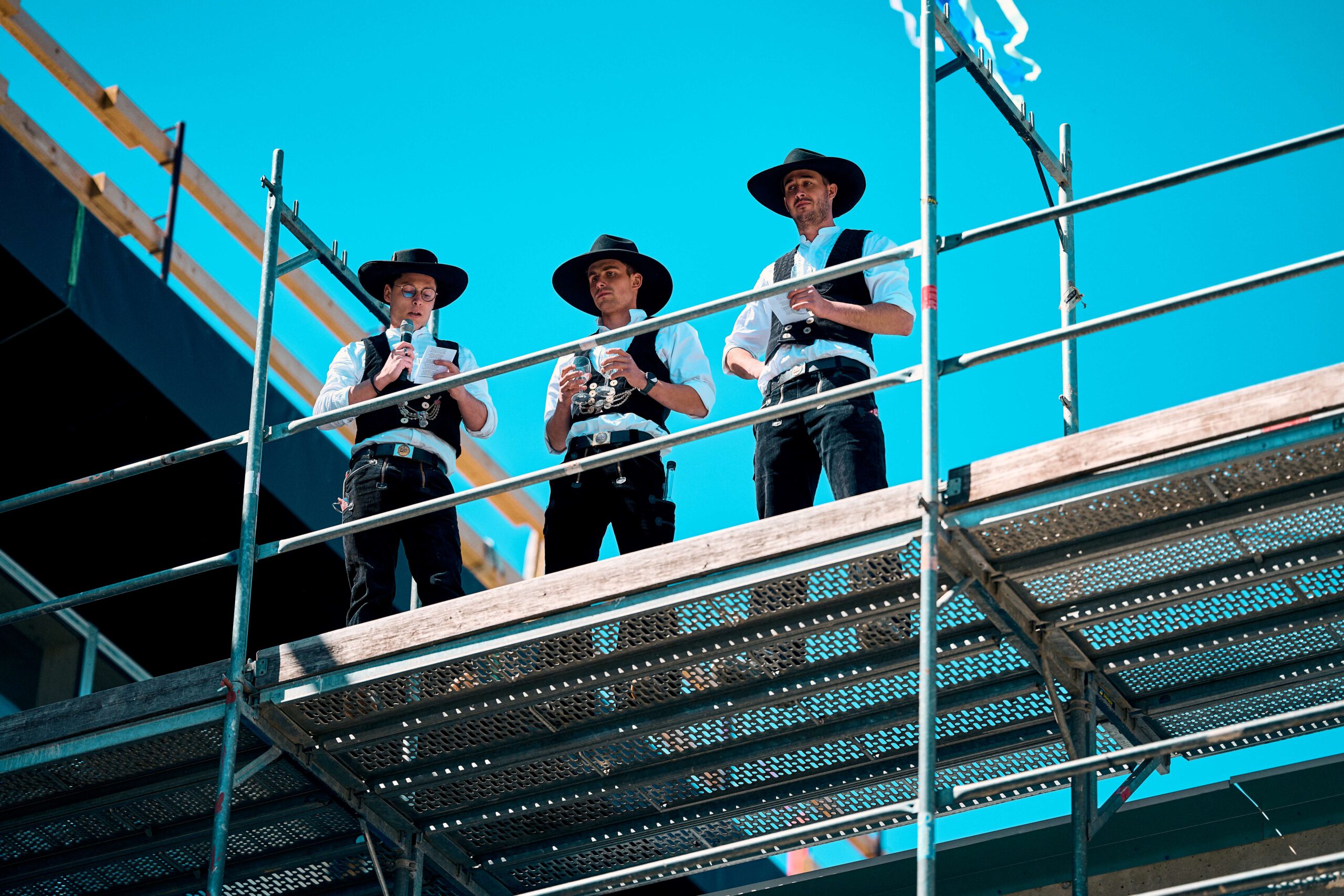
Düren’s Mayor Frank Peter Ullrich spoke of a powerful driver for urban development. WIN.DN Managing Director Winfried Kranz-Pitre emphasised that a vision was now becoming reality. The symbolic groundbreaking ceremony took place in front of around 120 guests. In addition to representatives from politics and administration at federal, state and Düren city level, representatives of the shareholders’ committee and the scientific advisory board also attended. The ceremony concluded with a traditional blessing from the roof of the technical centre.
You are currently viewing a placeholder content from Vimeo. To access the actual content, click the button below. Please note that doing so will share data with third-party providers.
More InformationYou are currently viewing a placeholder content from YouTube. To access the actual content, click the button below. Please note that doing so will share data with third-party providers.
More InformationYou need to load content from reCAPTCHA to submit the form. Please note that doing so will share data with third-party providers.
More InformationYou are currently viewing a placeholder content from Google Maps. To access the actual content, click the button below. Please note that doing so will share data with third-party providers.
More InformationYou are currently viewing a placeholder content from Google Maps. To access the actual content, click the button below. Please note that doing so will share data with third-party providers.
More InformationYou are currently viewing a placeholder content from Mapbox. To access the actual content, click the button below. Please note that doing so will share data with third-party providers.
More InformationYou are currently viewing a placeholder content from OpenStreetMap. To access the actual content, click the button below. Please note that doing so will share data with third-party providers.
More Information