



No steam leaves the paper mill: A sub-project of the Modellfabrik Papier research cluster is investigating how high-temperature heat pumps can revolutionise paper drying. This will make the most energy-intensive part of the paper production process more climate-friendly.
The lion’s share of the energy required in industrial paper and cardboard production is consumed in the drying section of the paper machine. Here, the remaining water that could not be removed mechanically in the upstream press section is thermally extracted from the paper web. Using heat and dry air, the water bound between and within the cellulose fibres is evaporated across several drying cylinders. Although the water content of the paper web is only low at this stage of the process, a good 60 per cent of the total energy consumption is used for drying alone in order to finally achieve the desired final dryness of the paper product.
This is precisely where working groups of Modellfabrik Papier’s research cluster FOMOP focus on: the integration of high-temperature heat pumps promises to make this part of the conventional manufacturing process in existing paper machines significantly more climate-friendly. “Put simply, we want to bring the waste heat that has previously been lost unused in the moist exhaust air back into the process. The high-temperature heat pump recovers water vapour and heat from the exhaust air and uses it to provide the saturated steam required for the drying cylinders,” says FOMOP group leader Dr Johannes Lunewski, summarising the approach.
Simple but effective: no steam leaves the paper mill!
Their basic principle is similar to that of heat pumps, which many people are familiar with from single-family homes: they extract heat from low temperatures in their surroundings and use electricity to raise it to a higher temperature level. The big difference lies in the dimensions and the target temperature: while a domestic heat pump is typically designed for 35–60 °C heating, industrial high-temperature heat pumps reach temperatures of over 120 °C. Just as in residential applications, they use energy that would otherwise be lost, such as from warm exhaust air, condensates or process water. Integrated into the drying section of paper machines, the heat can be retained in the system and reused. This saves large amounts of energy from fossil sources and reduces CO2 emissions.
Initial projects in the paper industry show that high-temperature heat pumps can provide a significant portion of the steam and heat required and fit well into hybrid systems and flexible, electrified energy networks.
Technical and operational limitations
Nevertheless, there are still a number of technical and operational challenges: drying the paper web, especially in the production of graphic papers and cardboard, often requires high steam temperatures or pressures that not every heat pump can deliver directly. This often leads to solutions in which the heat pump supplies part of the heat, while the rest is covered by existing steam generators.
In addition, efficiency and cost-effectiveness depend heavily on the temperature level and the properties of the available waste heat. “If the exhaust air contains more water vapour, the dew point is higher, which requires a higher operating temperature inside the hood to prevent condensation. However, this restricts access to the interior of the drying hood and increases the risk of corrosion of machine parts,” says Lunewski, explaining the problems. If this highly humid air were to be extracted locally and used as a source for high-temperature heat pumps, further challenges would arise, from additional space requirements to impairment of paper quality.
Keeping energy in the system
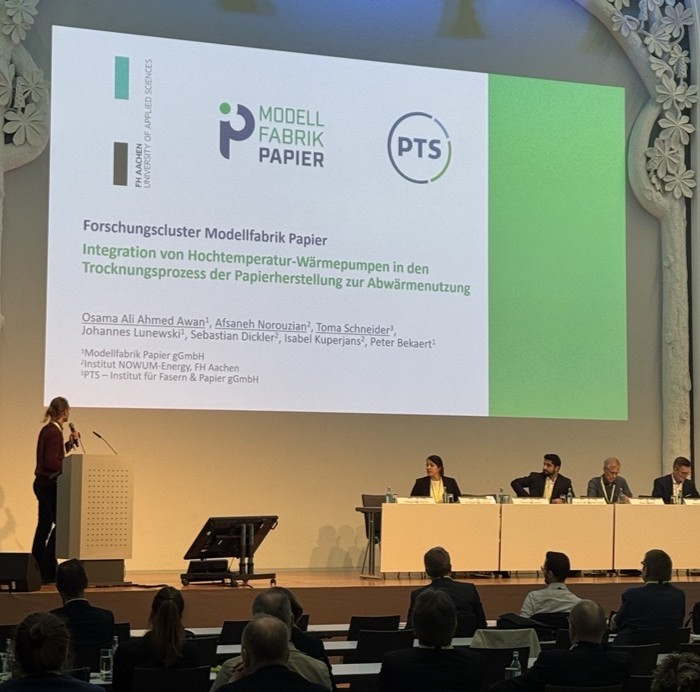
“The aim of our research work is to optimise the integration of high-temperature heat pumps into the drying section of paper machines and to accelerate the transition to more sustainable paper production”, says Lunewski. Together with various research teams from our research partners PTS – Institut für Fasern und Papier gGmbH and the Nowum-Energy Institute at Aachen University of Applied Sciences, we are working on innovative solutions in various work packages:

Modelling for the optimisation of moist exhaust air as a heat source: Using methods of computational fluid dynamics (CFD), sections of the drying hood are modelled to simulate the
flow behaviour in the pockets and in the vicinity of several drying cylinders and to identify condensation zones. Virtual tests can be used to test fixtures in the drying hood for regulating water vapour load.
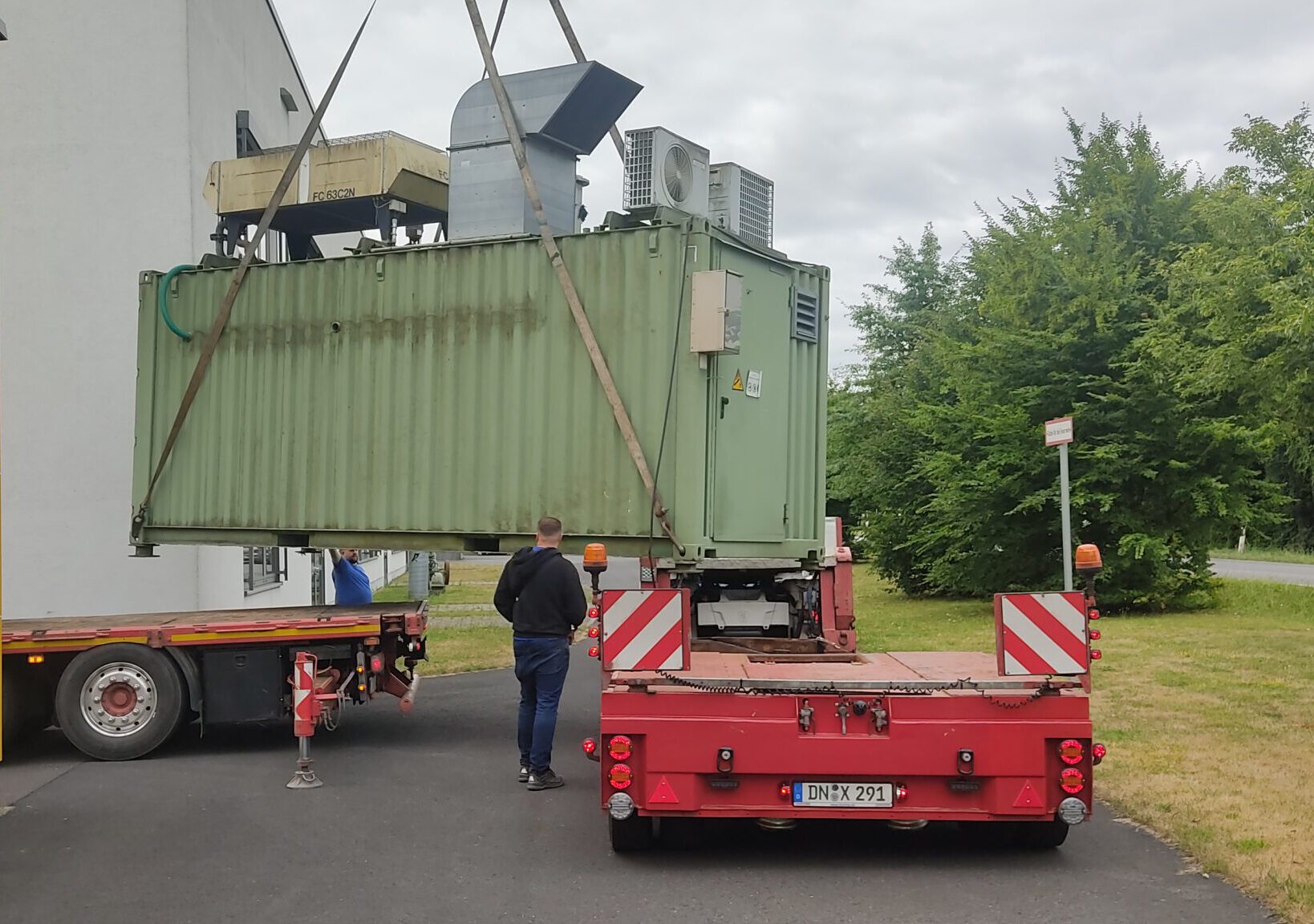
Development of a test rig for heat recovery: In order to efficiently recover the heat contained in the exhaust air and make it usable again, the water vapour is mechanically compressed using a compressor, i.e. brought to a higher pressure and the dew point is shifted, making the water vapour ‘hotter’ and causing it to condense more quickly. This heat can then be recirculated back into the production process and used for various purposes.
Development of a test rig for the alternative provision of saturated steam using a high-temperature heat pump with water as a refrigerant: The aim is to demonstrate that a water-based heat pump can convert low-temperature waste heat of 90°C into process steam of 200°C via a multi-stage compression process.
Following that, both test rigs will be combined in a pilot plant: The aim is to develop a self-contained system that utilises the waste heat from heat recovery and converts it into 200 °C hot steam, which is then fed into the drying cylinders. There, the heat energy is transferred to the paper web and condenses. This condensate is returned to the high-temperature heat pump circuit, absorbs heat again – and the cycle begins anew. This creates a so-called adiabatic process: a self-contained system that saves energy efficiently and uses it in a climate-friendly way.