


Hardly any other technology is changing industrial paper production as fundamentally as dry web laying. It overturns the traditional wet process, which uses water as the central transport and binding medium and opens up a completely novel approach to paper production inspired by textile technology. In the FOMOP research cluster, interdisciplinary research teams are working to develop this disruptive technology into an industrially applicable process that redefines the fundamentals of paper production.
Dry web laying: a disruptive path to climate-neutral paper production
Producing paper entirely without water? Dry web laying disrupts the established process in which water plays a fundamental role: the cellulose fibres are separated and evenly distributed in water. They swell, form hydrogen bonds with each other and mould themselves into a stable paper web. In modern industrial production, this process, which has been used since the invention of papermaking, has an enormous energy disadvantage: around 60% of the total energy consumption is accounted for by drying the paper web alone. Even the most modern pressing and drying techniques cannot completely compensate for this enormous effort: as long as water is involved in the process, it must ultimately be evaporated and removed from the paper.
A radical approach: paper without water
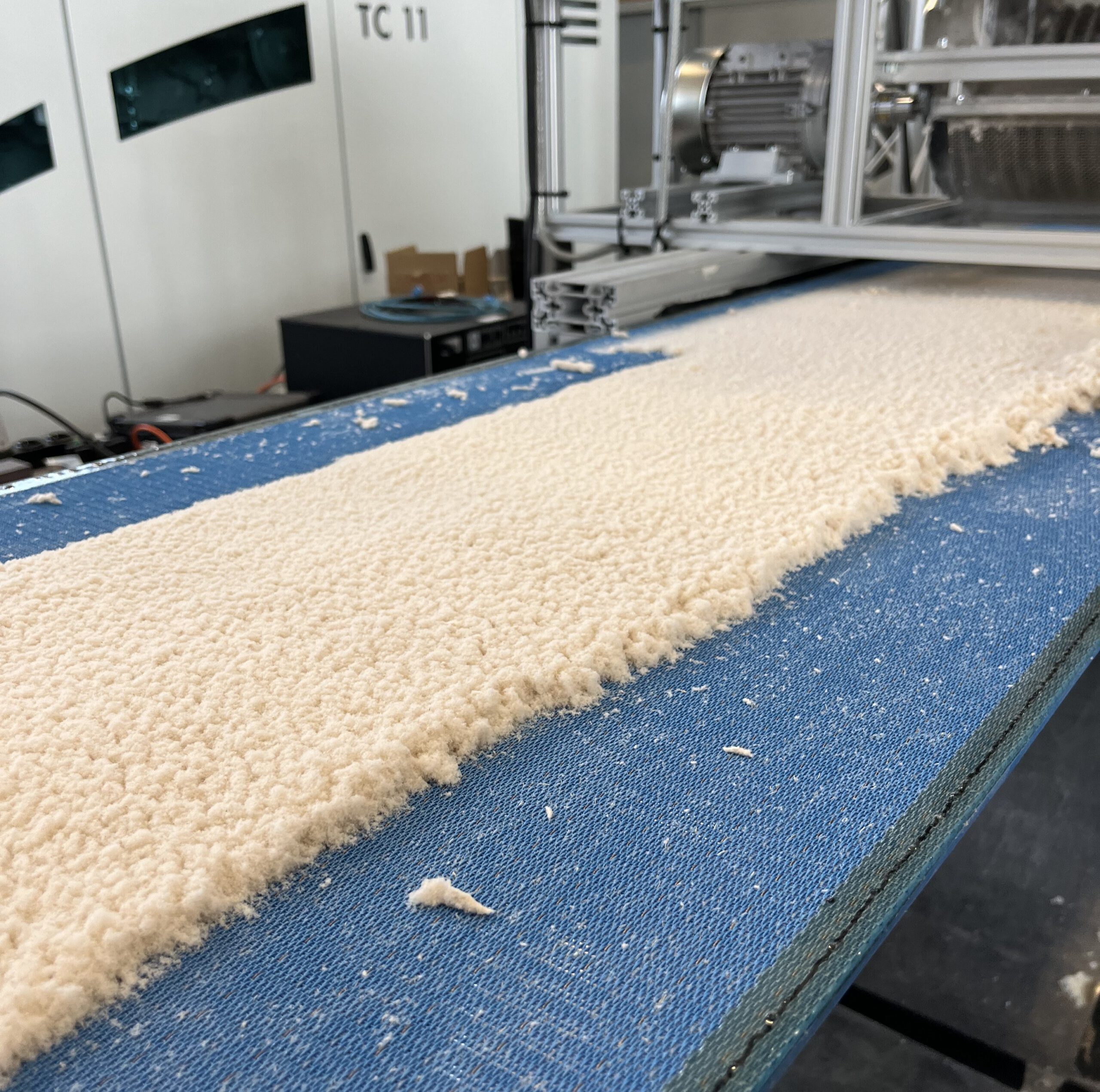
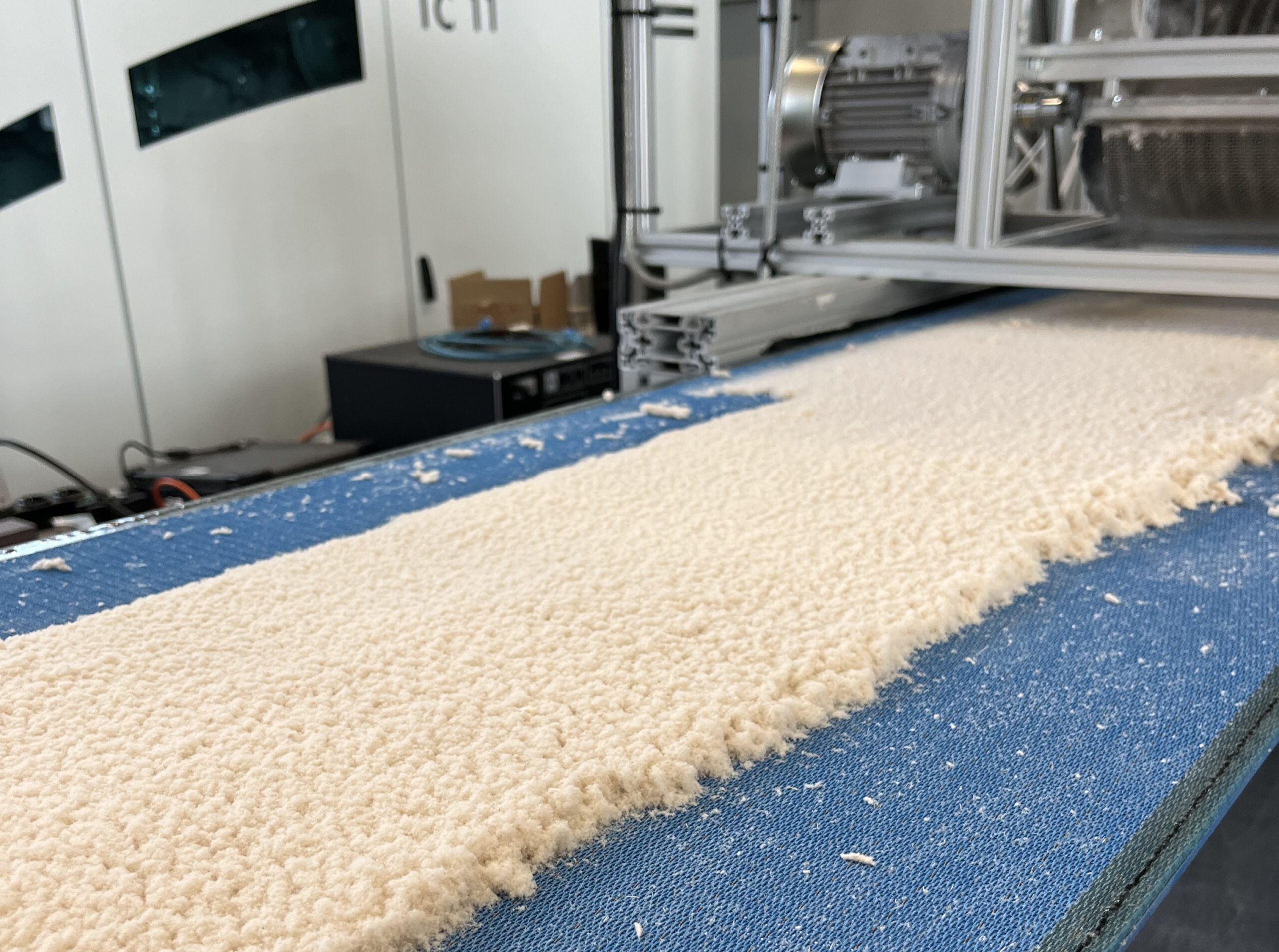
This is where dry web laying comes in: instead of water, air is used as the transport medium. The cellulose fibres are laid in a dry state to form a web, which is then consolidated – without any energy-intensive drying steps. Inspiration is provided by the airlaid process used in the textile industry, which produces nonwoven fibre structures. Initial applications also exist in the paper industry, for example in the manufacture of paper napkins. However, these processes are often limited by high air mass flows with corresponding energy requirements. They also have limitations in terms of product properties and achieve only low production speeds.
FOMOP: Collaborative research – from idea to programme
In its FOMOP research cluster, the Modellfabrik Papier is driving these developments forward together with its research partners, the Institute of Textile Technology at RWTH Aachen University (ITA) and Dresden University of Technology. ‘We apply principles of textile technology to paper production. Instead of aqueous suspensions, we use dry fibre webs, which are then consolidated,’ explains MFP group leader Steffen Flaischlen. In addition to potentially enormous energy savings, this opens up new degrees of freedom in the choice of materials and structural design.
‘Our goal is to overcome these limitations and develop a scalable technology that can one day achieve industrial mass flows comparable to modern paper machines,’ says Flaischlen. Key aspects include uniform fibre distribution with reduced air flow, as well as the development of sustainable, recyclable additives and new bonding mechanisms that do not interfere with established paper recycling processes.
From idea to plant: a test bench for continuous dry paper formation
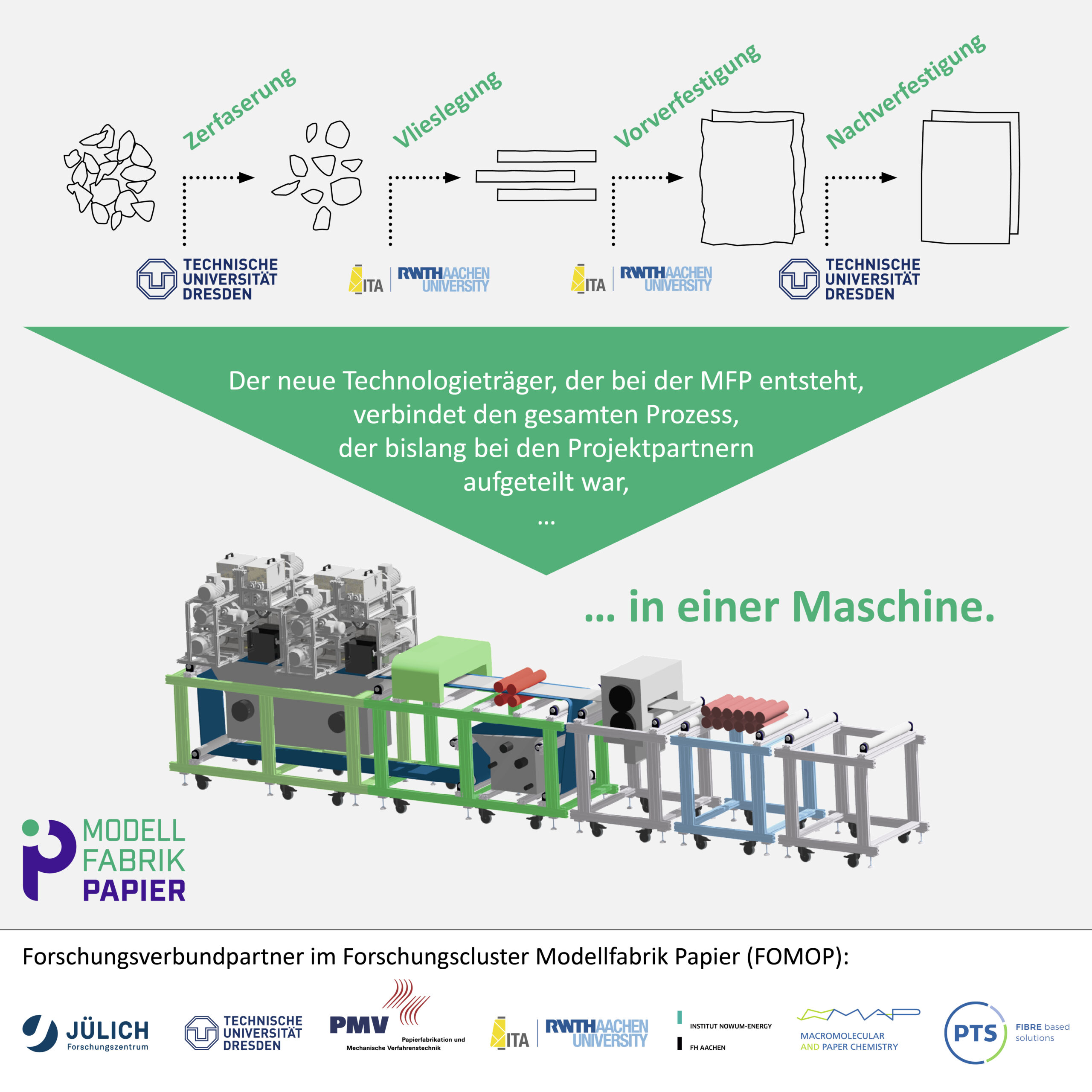
‘We are currently developing a new modular test rig that combines two key technologies in a single plant for the first time: Airlaid-inspired dry fibre web formation and web consolidation,’ says Flaischlen. ‘This combination allows us to investigate and further develop
reproducible, homogeneous fibre distribution in a fully continuous process on a scalable basis for the first time.’ Until now, only disjointed or severely limited individual processes have been available. The new test rig now realistically replicates future industrial processes on a smaller technical scale.
Initial tests – dry paper sheets made from fresh fibres, laid on a preliminary pilot plant and then consolidated offline – show promising results: the samples presented at the ZellchemingEXPO 2025 at the Modellfabrik Papier stand already achieved tensile strengths comparable to those of conventionally manufactured paper – a milestone in dry paper production.
“Our test rig paves the way for radically lower energy consumption and leads to completely new design possibilities for future paper products.”
Simulation as a key technology
Continuous dry web formation still has to solve a number of technically challenging issues: air is much more difficult to control as a transport medium than water. It creates turbulent flows that make it difficult to deposit the fibres evenly and promote fluctuations in basis weight. Without the advantages of water for fibre swelling and the formation of strong hydrogen bonds, alternative, recyclable bonding concepts must be developed that also enable the desired strength properties.
“To solve these problems, we are relying on a combination of experimental research and computational fluid dynamics (CFD) methods. With the help of CFD simulation, we can analyse three-dimensional flow processes and the transport of individual fibres in the forming area in detail. This gives us insight into the interior of the machine that would not be possible with conventional measurement technology,” says Flaischlen. This method makes research much faster. In addition, variants and process parameters can be tested virtually in this way to ensure the correct design of the prototype before the actual construction of the plant.
Looking ahead
Even though scalable implementation on an industrial scale will require several more years of intensive research and piloting, the direction is clear: an industrially applicable drying process that enables mass flows similar to those of today’s paper machines – while at the same time making a fundamental contribution to the decarbonisation of the industry.